Beacon's Superintendent Encourages Everyone To Take 2020 Census - Explains Benefits

beacon-superintendent-encourages-census-2020-MAIN.png

It’s Census 2020 time, which is an opportunity for the City of Beacon and the Beacon City School District to benefit from new financial opportunities and incentives. Beacon’s Superintendent, Dr. Matthew Landahl, published on his Superintendent’s Blog a message encouraging people to participate in the Census.

The Census begins on April 1, 2020, and every household in the country can participate in it. “An accurate count is critical as the results will be used to determine funding for a range of programs, including many that our students and our school districts rely upon. Unfortunately, many households did not participate in the 2010 Census and that number is expected to increase this year,” said Dr. Landahl in his blog post.

”Some households are concerned that their responses will be shared with other government agencies,” he continued. “This is not the case and respondents should know that their participation can only benefit them, their families, and their communities.”

To learn more about the process and how it benefits public schools, visit this link.

The Recycling Market That Crashed - How The Crash Impacted Beacon

Photo Credit: Katie Hellmuth Martin

Photo Credit: Katie Hellmuth Martin

EDITOR'S NOTE, BEFORE YOU READ:
This article was written in 2018 and never published; we missed the window of timeliness. Now, with the Plastic Bag Ban, we are publishing it. It helps serve as a background to any changes in recycling, trash collection, and any new environmental regulation.

During a City Council Workshop meeting on May 29, 2018, at which the City Council was talking to Royal Carting (the garbage company that picks up our trash) about the following year’s trash and recycling pickup contract, a few observational comments were made by then-Mayor Randy Casale and Councilperson at Large George Mansfield about how the recycling market had turned "topsy-turvy," in part because what is being put into the recycling bin is contaminated - aka coated with food and other nonrecyclable materials. 

Beacon Used To Earn Money From Recycling - Now It’s An Expense

Beacon used to make money off the recycling collected from homes. There was a market for purchasing recyclable items like cardboard and plastic. However, thanks to China tightening its requirement on how clean the recycling needs to be - almost 100 percent clean, as in rinsed, no food on it, no soggy paper, no plastic bottle caps floating around the recycling bin, that sort of thing - Beacon is paying to have the recycling taken away. That’s a hit to Beacon’s budget.

Worse, the recycling that is being taken away might not be getting recycled at all since China won’t buy most of it.

Deep Dive Into The Recycling Problem

We are taking a Deep Dive into this issue, because when you ask yourself: "If it's not being recycled, where is it going?" you get some pretty bleak images of the floating barge of trash around New York City, the wad of plastic floating around the ocean, the massive amounts of methane gas coming from piles of trash, and food waste in landfills causing methane fumes.

You quickly see how there is not enough space on Earth to put the trash. And no, shooting it up into space is not an option. Space is already littered with orbiting satellite debris from when countries experiment with shooting things up there (yes, they have actually mapped out each floating piece of "space junk" if it's the size of a softball or larger to track it). So what gives?

Kayleigh Metviner Zaloga introduces us to the issues in order to help us discover and create a solution. But first, you'll need to get familiar with these basic ideas:

  • Money: Recycling is good for the planet, but it has to pay for itself and be profitable in order for it to be done. Businesses have been created to deliver recycling solutions: They collect the goods, sort them, clean them, even using technology to identify it (with high-tech machines and people who sort), and sell it to other businesses, who turn it into carpet or clothing or recycled paper, which consumers then buy as retail products.

  • Value: Different types of recycling, like glass bottles, newspaper, cardboard, or plastic to-go containers, have different values for these businesses. A single item, like a plastic laundry detergent bottle, might have a really high value (but is dirty inside with the last drops of detergent, so the processing center has to clean it). A wine bottle, on the other hand, is really recyclable, but is dirty inside with old wine. Cleaning the inside of a tall and narrow glass bottle is difficult and costly, which kills its market value.

  • A Solution Caused A Problem: Sadly, the invention of "single-stream" recycling, which is when you can throw ALL of the recycling into one can, is now messing up the system because it's all too much to sort. Oddities like a single bottle cap from a plastic water bottle is considered "contamination," but if that cap is attached to the bottle, it's all good. So convoluted.

  • Buyers: China was the biggest buyer of paper to be recycled. They didn't care if it was a little dirty. Now they do. As of January 1, 2018, they basically put the kibosh on buying it. This has created backed-up piles of compressed recycled paper waiting to be reused, but those bundles sit at recycling processing centers with nowhere to go because no one is buying it.

  • Food: Food makes up most of our trash. And wrecks a lot of recycling! Good news: Food composting is really easy!!! You just scrape the food into a special bin with a critter-proof lid, and have companies like Community Compost Company take it away to be turned into rich soil, without any of the big technology involved.

OK, now you're ready for Kayleigh's article on where this started:

Recycling in Communities

By Kayleigh Metviner Zaloga

Most people don’t realize that municipal recycling (aka household recycling) worked so well for so long because certain materials in our trash, like newsprint, glass, and plastic bottles, had economic value and could be sold to make everything from copy paper to carpets, making recycling profitable for processing facilities and a boon to city budgets.

In 2016, the City of Beacon was paid for every ton of recyclables picked up from residents and brought to the ReCommunity (now Republic Services Recycling) processing center.

The increase in recycling also reduced the volume of trash in everyone’s bins, saving the city money on garbage disposal. It was a win-win, both financially and environmentally. But at a presentation at a City Council Workshop on August 27, 2018, Steve Hastings of Republic Services informed the City Council that “recycling is broken,” profits are nowhere to be seen, and the current model may not be sustainable. Governor Cuomo has called for a series of meetings on what to do with the recycling being collected that may be ending up in landfills, and Beacon’s former mayor also indicated, in a past City Council meeting on May 29, 2018, that other counties in the state may stop recycling all together.

What’s Going On?

There are three main factors in this recycling industry sea change:

American mixed paper used to sell for an average of $75 per ton. Now it sells for $5 per ton.

1. China Basically Stopped Buying Lots of Recycling on January 1, 2018
China was the largest importer of recycled materials for decades, and the United States was one of its largest sources. Effective January 1, 2018, however, the Chinese government banned the import of 24 types of solid waste, including scrap plastics and mixed paper. They used to have a 3 percent contamination cap that, according to Steve, was rarely checked. Now they have a 0.5 percent contamination cap, and it is regularly checked by China by opening up bales of processed recycling at the docks, and sending it back if it has more than 0.5 percent dirtiness. Steve says it's an impossible standard to hit, despite their efforts. This triggered a huge drop in the prices that various municipal recycling components sold for. For example, American mixed paper used to sell for an average of $75 per ton. Now it sells for $5 per ton.

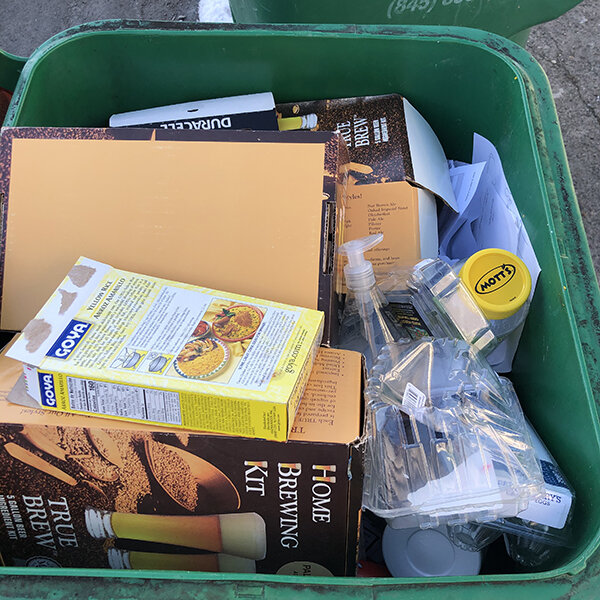
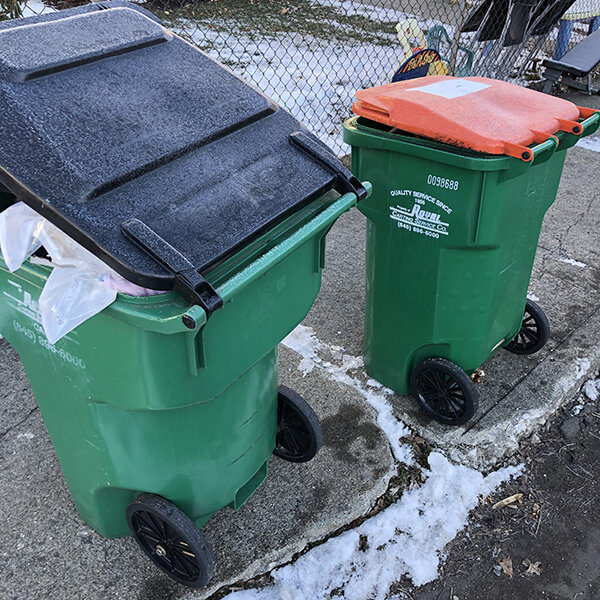
Recycling needs to be 100 percent clean before going into the bin. Any plastic with food on it won’t be recycled. Wet paper or cardboard won’t be recycled, either. Photo Credit: Katie Hellmuth Martin

Recycling needs to be 100 percent clean before going into the bin. Any plastic with food on it won’t be recycled. Wet paper or cardboard won’t be recycled, either.
Photo Credit: Katie Hellmuth Martin

2. Contamination: Food (i.e. Dirty Recycling)
The leftover lettuce in your plastic salad to-go container. That last scoop of peanut butter in the jar. Yogurt still in the yogurt cup. Wet cardboard. Plastic grocery bags. Garden hoses. Greasy pizza boxes. Plain old garbage. All of these are things that do not belong in recycling bins. Throwing them in anyway contaminates all of the salvageable materials; worse, it can result in whole loads of recyclables being sent to a landfill. High contamination levels were also one of the main reasons the Chinese government banned many foreign recyclables.

People really need to have it sink in that recycling is really just a band-aid at this point… The reality is that a lot of it doesn’t end up being recycled. People will throw everything they think of in recycling that might work, and it becomes dead weight for the company that processes it.
— Atticus Lanigan, Owner, Zero to Go

3. “Wishful Recycling” - Feel-Good Recycling That Actually Kills Recycling
”Wishful recycling” was a term Steve used, for when someone throws something into the recycling container and feels good about it, but that thing is actually not recyclable. Like plastic of the wrong recycling number, a dirty wine bottle or yogurt quart, or soggy paper or cardboard. He actually stressed this directive: “When in doubt, throw it out.” They really don’t want mistaken recycling. At all.

Plummeting Profits In Recyclables Could Kill Collections

No one ever thought there was a cost to recycling because the commodities covered it,” Hastings told the City Council. “So then when the commodities market flipped on its ear… Now all of a sudden it’s a red mark on every budget across the country.
— Steve Hastings, Republic Services

Since the announcement of the Chinese ban, prices in the recycling market have plummeted. Republic Services in Beacon is still accepting and processing mixed paper and newsprint, but high contamination rates and low prices may drive the facility to reconsider, Steve informed the City Council at the August workshop meeting.

Although reducing the volume of garbage in landfills is a good thing, simply shifting that garbage to recycling facilities is not. If the material cannot be processed, sold, and reused, it will likely end up in the landfill anyway.

“No one ever thought there was a cost to recycling because the commodities covered it,” Hastings told the City Council. “So then when the commodities market flipped on its ear… Now all of a sudden it’s a red mark on every budget across the country.” A complete market flip is no exaggeration: Materials that Republic Services sold for $120 per ton in July 2017 dropped to only $32 per ton last month (editorial reminder that this was originally written in 2018) after China’s ban was in place.

What Is Happening To Individual Markets for Recycling?

recycling market-1.jpg

“We do have to come up with a model that is durable, sustainable … and isn’t captive to just the commodity values,” Hastings said. Glass, for example, is no longer a profitable material to process in most municipalities because it breaks, and in fact has a “negative recycling value,” meaning most recycling facilities have to pay for the material to be sorted out of the other recycling, then hauled away instead of selling it for a profit. The glass collected in Beacon's residential recycling bins is currently sent - at a financial loss - to a processing facility in Allentown, Pennsylvania. Some counties upstate have been transferring their glass to landfills for years. Here, it sounds like you should cart the glass bottles to Key Food or Hannaford, or to the local place in Beacon that can allocate your money back to a local PTA/O for Beacon school kids.

Some Counties Across the Country Are Stopping Single-Stream Recycling

Even though glass, newsprint, and certain metals and plastics can be recycled and remade into all kinds of products, plummeting prices, rising processing costs, and constricting markets are making recycling industry analysts and municipal leaders alike reconsider the current system. In some parts of the country, especially in western states like Idaho and Washington, municipalities have stopped collecting the materials they can’t find a market for, like the scrap plastics and paper now banned by China. Other communities, like Saugerties, are ditching single-stream for different collection bins and then use Beacon’s recycling location to dump commingled products.

Is It The Tariff War? China Warned About Contamination For Years

Contamination, also known in the industry as residue, is all the stuff that can’t be recycled by a particular facility and should not be mixed into the recyclables sent there. A high contamination level makes processing materials more difficult, and it was also the driving force behind China’s import ban. As more and more municipalities implement recycling programs, especially the single-stream variety that lets residents throw all of their recyclables into one container, companies that process these materials are noticing higher levels of contamination in the resulting haul.

But China Needs and Wants The Recycling - They Are Hurting

China used to buy pulp for $220 a ton. After the ban, they buy it for $700 a ton.
— Steve Hastings, Republic Services

China is not having a great time with this ban either. The thing is, Steve explained, China needed our recycled paper for pulp. They don't have their own pulp, and they need to buy it. According to Steve, China used to buy pulp for $220 a ton. After the ban, they bought it for $700 a ton.

“So where is the savings for China?” Councilperson George Mansfield asked.

“There is no savings," explained Steve. "It’s a disaster on the Chinese front for the capitalist side of China. From the government standpoint, they have an anti-pollution campaign they are running hard. We never thought they would go six to eight months without the material [pulp aka paper].”

Whether it be nonrecyclable materials (like diapers, garden hoses, and syringes) or simply recyclables that have too much food garbage on them (peanut butter jars and to-go containers are notorious for this), contamination has become an increasing - and increasingly costly - problem.

Since too much contamination, even with other types of recyclable materials (e.g. glass in the newspaper bale), renders materials essentially useless, recycling centers need to spend more and more resources sorting and cleaning everything that is dropped off. This involves buying or inventing more elaborate technology, as well as hiring people to pick through the recycling, remove inappropriate items, and clean debris off materials.

At the Beacon Republic Services facility, the mixed recyclables move through “a series of sorting tables, devices, magnets, opticals, and people” - over 50 people per shift - to end up separated by material and grade, explained Steve. Spending more on processing would not be a problem if there were increasingly profitable markets for the end products, but that is where some of the biggest changes are taking place. Because the profits have disappeared, processing centers may close altogether, thus eliminating those jobs. Already, one of the biggest processing centers in the country in Miami has closed "overnight," said Steve.

Worldwide Trend of Rejecting Dirty Recycling

The Chinese government’s main reason for banning foreign recyclables and lowering contamination limits was that the materials were coming in too highly contaminated and were creating an even bigger pollution problem for the country. Although American companies have responded by increasing their exports to other countries, primarily in Asia, some of these countries appear to be following China’s lead and may institute their own limits and bans.

Republic Services currently sells materials to Indonesia, Malaysia, and Vietnam, but the shipping costs to these countries are significantly higher than what it used to cost to ship to China. Trading with China also had the added benefit of forming a kind of shipping loop, where U.S. recyclables were shipped on containers to China, and Chinese manufacturers shipped finished goods back to the U.S.

An Opportunity For A U.S. Recycling Market? Maybe, But Risky…

Would the U.S. market develop to replace the work that China was doing? "We’d love to see it," said Steve. But investing in a new facility is a risk. What if China opens up again? "There have been two paper mills open in the last 10 years in North America. They are both in Indiana, and they are both cardboard manufacturers. They’re dead in the middle of the country because of the fear that [if] the export economy opens up again, they fear they won’t be able to compete again."

As for domestic markets, there is simply not enough demand for these kinds of production materials in the U.S., though that could change in the future. A strong need for something always inspires entrepreneurs to bring on the solutions. In the meantime, American recyclables are looking at other options.

Real-Life Effects At Home In Beacon

“We are at a crisis at this point,” said City Council member Amber Grant at the Workshop meeting. "The fact that we’re barely even recycling what we think we are, and now we have this issue on top of it which will now impact people's pocketbooks... We need to teach people how to recycle better and give them the tools to do it." Councilperson John Rembert voiced his agreement.

“The economics are critical,” Steve said. “The model is broken the way it’s written. The processors need to get a processing fee, and the commodity piece has to be a shared component of it."

It has only been two years since we last looked at the costs and benefits of recycling in Beacon, but we are a long way from the days when the City earned money from each ton of recyclables collected. That additional income is no longer part of the arrangement, and going forward, Republic Services will seek a new rate structure to cover the increased processing costs that are not made up for by selling the materials.

In addition to considering how processing facilities are paid, Steve and the City Council members discussed limiting the materials that can be thrown into the single-stream recycling bins. “We have to simplify what we put in there,” Steve said. “There are a lot of items that can be recycled, [but] they may not belong in the [recycle bin].”

The hope is that by collecting fewer items and emphasizing the need to clean and dry objects before throwing them in the bin, there will be less contamination and more usable material. This is not to say that everything else should be sent to the landfill, however. Steve suggested having drop-offs and other arrangements for other materials.

Addressing The Crisis At The New York State Level

At the New York State level earlier this month, Governor Andrew Cuomo directed the Department of Environmental Conservation to convene stakeholder meetings to identify how the state can improve recycling and even “expand municipal recycling programs” in the face of changing global markets. One goal of this initiative will be to identify open markets for recycled materials. The inaugural meeting was on August 29.

Suggestions to Save Recycling

People's behaviors will need to change if any trash is going to be reduced. Here are some suggestions:

  • Reuse the durable products that can have a second life right in your own home, like glass jars.

  • “When in doubt, throw it out,” said Steve. Ouch! Only throw in items that you know are accepted by your local facility. Even though we may want more goods to be recycled, this aspirational recycling only leads to higher contamination rates and more materials being sent to landfills.

  • Clean It: “Clean material is the answer,” said Steve. Thoroughly clean any food debris, laundry detergent, and other non-recyclable materials off containers. Consider switching to powder detergent in the cardboard box.

  • Cap It: “If a cap falls off a bottle, it’s residual [aka contamination]. If it’s on the bottle, it’s great.” Screw lids onto plastic bottles before throwing them in.

  • Glass Bottles - Skip the Bin: If you want to give your glass bottles a better chance at being turned into new bottles, put them in the specialized bottle deposit machines that sort them, crush them, and keep them free of contamination.

  • Food Composting - For Real! 40% Reduction in Trash: Aside from smarter recycling, Atticus Lanigan, owner of Zero To Go, an education-based waste management company focused on composting and recycling in Beacon, also suggests taking a hard look at the other types of waste we routinely throw away. “40 percent of our waste is organic and rots in landfills,” she said, even though much of it can easily be composted. “People really need to have it sink in that recycling is really just a Band-Aid at this point… The reality is that a lot of it doesn’t end up being recycled. People will throw everything they think of in recycling that might work, and it becomes dead weight for the company that processes it.”
Get Beacon's Updated Recycling Guide!

To Be Continued...

This story about how recycling as we know it is in jeopardy is to be continued, as perhaps we all make changes to reduce our footprint, both in terms of our rotting trash and the greenhouse gases it emits, as well as the growing stock of recyclable material that can’t rot and has nowhere to go.

BeaconArts Holds Annual Meeting For 2020 Board Elections On Wednesday

beacon-arts-holds-annual-meeting-for-2020-votes-MAIN.png

BeaconArts, the multifaceted art organization that started in 2002 and helped revitalize Beacon by making arts projects accessible through their fiscal sponsorship programs, is holding their annual meeting to go over financials and revised bylaws, and to elect or re-elect board members on Wednesday, January 29, 2020 at Industrial Arts Brewing Company from 6:30 to 8 pm. (Read our recent feature on Industrial Arts and the food truck you’ll find there, Eat Church.)

Additional candidate nominations are being accepted via email through Tuesday, January 28, 2020. Email meghan@beaconarts.org with a nomination. You must be a current member of BeaconArts to vote. You can renew or start your membership here.

BeaconArts can be credited with being involved with or a fiscal sponsor of several projects you are familiar with, including Beacon’s new free bus, the Beacon Free Loop (the G line), art in the bus stations, Beacon 3D (public art sculptures throughout town), Beacon Open Studios, and more. It is because of their work, and the energy and and enthusiasm of their members, that Beacon maintains its unique vibe.

During 2019, the Board of Directors consisted of:

  • Co-Presidents: Meghan Goria & Karlyn Benson

  • Vice President: Angelique Devlin

  • Treasurer: Aaron Verdile

  • Secretary: Christina Jensen

  • Members at Large: Michelle Alumkal, Jonathan Berck, Donna Mikkelsen, Terry Nelson, Chris Neyen

  • Ex-Officio: Ed Benavente, Kelly Ellenwood

  • Past BeaconArts Presidents: Theresa Goodman, Rick Rogers, Kelly Ellenwood, Dan Rigney, Linda T. Hubbard, Sara Pasti, Ricardo Diaz

You can learn more about current and hopeful board members here.

New and Easy Guidelines To Recycling In Beacon To Avoid "Wish Cycling"

Before the representative from ReCommunity (acquired by Republic Services), Steve Hastings, presented his in-depth “Recycling Has Halted and Here’s Why 101 Class” to City Council back in May 2018, it was easy for people to say: “My recycling bin is full! I recycle everything! It’s great!”

recycle2.jpg

Thing is - it wasn’t great - and all that extra stuff that may have been thrown into the recycling bin - like a kids’ toy, a dirty bottle of liquid laundry detergent, or a yogurty yogurt cup - was and is contaminating the recycling batch, rendering it useless. And while Steve never committed to saying what happens to disposed of matter that is not recycled, you would need to just think about where the recycling goes when it can’t be recycled - straight to the trash. Wherever that is, and in whatever form that takes.

After the de-brief and the resulting feelings of “Horrors! This is awful! Nothing I am recycling is probably being recycled!” people wanted clearer guidelines. The Beacon Green Coalition heard that call loud and clear, and developed a nifty new flyer in 2019. You may still see it hanging around. Ask the city to email you one if you want to print it out at home. Here’s what it says:

“Wish-cycling” - When You Think You’re Recycling But Really You’re Just Messing It All Up

Steve the recycling professional stressed the harmful effects of “Wish-Cycling.” That moment when you empty the applesauce jar and you toss it into the blue bin. Or when you just finished a sushi meal and you toss all of the soy sauce- and wasabi-covered plastic plates into the blue bin. Or when you’re cleaning out your kid’s toy room, and you recycle about 20 little plastic toys and lone battery backs.

“When In Doubt, Throw It Out”

Steve actually said this during the presentation in 2018. Several times. He begged people to throw away things if they weren’t sure if it should be recycled or not. But how do you know? How would you know that soggy cardboard or a meat juice-soaked paper bag was not eligible anymore for recycling?

In the past, the only way to know what to throw into the recycling bins were noted on the labels affixed to their lids but after some time, those labels tend to fade in the elements.

In the past, the only way to know what to throw into the recycling bins were noted on the labels affixed to their lids but after some time, those labels tend to fade in the elements.

The Easy-Peasy Recycling Guide

Here’s the breakdown of everyday items that can or cannot be recycled, as produced by the Beacon Green Coalition:

Rigid Plastic

YES (rinse everything)
Beverage containers: jugs, bottles, cups.
Food containers: clear clamshells, tubs, laundry detergent bottles (but rinse it 100% - if you can’t, then switch to powder)

TIP: If it’s paper or plastic and smaller than a credit card, throw it out.

NO
Plastic bags, straws (they always slip out of the recycling batch - too small), plastic utensils (forks, knives, spoons), caps (smaller than a quarter - just screw it back onto the beverage container), plastic wrap, Styrofoam, items smaller than a credit card.

Paper & Cardboard

YES
Newspapers, magazines, brochures, paper bags, mail including junk mail, envelopes with plastic windows, phone books, waxed cartons (e.g. juice and milk), shredded paper in a clear tied bag, corrugated cardboard and paperboard boxes, paper towel and toilet paper rolls, foil-lined cartons (for soup stock, etc).

NO
Soiled paper, food-soiled paper plates, pizza boxes, tissues, paper towels, coffee cups or lids.

Metal

YES
Aluminum and metal cans, metal jar lids and caps, empty aerosol cans, rinsed foil wrapping, pie plates, and trays.

NO
Hangers (return to dry cleaner), scrap metal (bring to a scrap metal recycler), foil juice pouches.

Glass

YES
Bottles and jars, other food containers, beverage containers, all cleaned glass products (even broken ones),

NO
Pyrex, ceramics, light bulbs, window glass.

Don’t Recycle These Household Items:

  • Batteries, electronics, cords (can be recycled at Best Buy - even Christmas lights!).

  • Plastic bags (take them to any large grocery store).

  • Plastic children’s toys

Handy Tips

Rinse rinse rinse! It’s a total waste if you don’t. You might as well not throw it into the recycling bin. It contaminates the entire batch. China won’t buy it, and we’re sunk.

Don’t bag the recycling - loose loose loose! Unless it’s shredded paper. And then put it into a clear plastic bag.

When in doubt, throw it out. :(… But let’s just know what to recycle in the first place, thanks to this handy guide from the City of Beacon and Beacon Green Coalition!

The Plastic Bag Ban Is Real - How's It Going?

Photo Credit: Brianne McDowell

Photo Credit: Brianne McDowell

Just last month, it used to be hipsterish to carry your tote bags to a grocery store. Forget about pulling them out at any other type of store, like a gas station, Rite Aid, or big-box store. You would just look plum “alternative” if you did (not that there’s anything wrong with that). Plenty of people carried the tote bags with pride, and showed off their tote bag collections from different magazines and brands they love, while others sometimes remembered to bring their totes stored in their cars. Now, thanks to the statewide ban on the single-use plastic bag (those plastic bags you see whipping around roads and catching on trees), everyone is carrying whatever bags they can remember into stores. Or maybe they are still carrying nothing at all.

“My husband came home the other night with groceries falling out of his arms,” recalled one Beacon resident. “Now he is trying to remember to bring the reusable bags in the car.” Common stories include people forgetting their reusable bags stashed in the car, only to dash out of the store to quickly grab them. Grocery stores like Key Food are making the paper and plastic reusable tote bags available at checkout. New York did not require stores to charge for the paper bags, as a deterrent to using any single-use bag, but many stores are charging 5 cents for the paper, and another rate for the reusable plastic tote. Key Food is charging 5 cents for their paper bags, and 99 cents for their reusable plastic bag, while Stop and Shop in Poughkeepsie is charging $2.50 for their reusable plastic bag. Beacon Natural is charging 5 cents for the paper bags, and does sell their cloth tote bag for $10, but has flash sales for $3.99 from time to time.

According to an article in the Poughkeepsie Journal, the cost of paper bags to a retail shop has increased. Nicole Wronga, owner of Simplicity, a consignment store, told the newspaper that the cost of 250 paper bags has increased from $42.50 to $47.50 (that equals 19 cents per paper bag, so even selling it at 5 cents is a loss for some who don’t order in huge bulk). It has caused Nicole to begin charging 5 cents for a paper bag, with 3 cents being donated to the state environmental budget, to encourage customers to bring their own bag.

Over here at A Little Beacon Blog, we sell tote bags, and now with the flooded market of totes (because we all need them), the price you might pay just plummeted. So, it costs us $7.50 to produce the bags locally in Newburgh, and we’re charging $10 right now.

BYO Bag - Bring Your Own Bag

New York State is branding this ban as BYO Bag (Bring Your Own Bag). Do you remember back in the 1990s, when the giant yellow plastic bags with blue handles were the rage? They were so giant, hardly anyone could really carry a full one. They equaled about three paper bags of groceries. Typically associated with Ikea bags, but sometimes sold by the Girl Scouts at grocery stores to encourage people not to use paper bags. The reusable bag has been tried before, but now it’s officially locked in. At least we know that paper bags are recyclable, but only if they are 100% dry, clean, and not wet with food.

Are Plastic Bags Of Any Kind The Answer?

Dutchess County uses about 100 million single-use plastic bags per year, according to the county legislature. In New York State, about 23 billion plastic bags are used each year. Year. That’s a lot of bags. Nick Wise, a shopper at Target who was quoted in the Poughkeepsie Journal, is from London, where the bag ban was phased in 10 years ago. From that ban, he experienced reusable plastic bags going to waste. With one of his reusable plastic bags already having a rip: “I know I can reuse them as much as I can, but they are going to end in the garbage at some point,” Nick told the Journal.

When word was coming down of the plastic bag ban, some retailers didn’t believe it would happen. And then Marc Molinaro, County Executive for Dutchess County, signed it into law in December 2018. Dutchess County’s ban went into effect January 1, 2020. Ulster County’s County Executive signed theirs into law in October 2018, while Suffolk County added a 5 cent charge to single-use plastic and paper bags in January 2018. And then New York State brought it all down with a state ban, set to go into effect in March 2020, which will eventually make it all less confusing. No single-use plastic bags anywhere in the state.

Plastic Bags In Trees, In Streets, In Recycling

Recycling executives have cited plastic bags as one of the most disruptive contaminants to their recycling production, which adds to the taxpayer cost of recycling in Beacon. During a 2018 presentation from Beacon’s recycling facility, ReCommunity (acquired by Republic Services), Steve Hastings explained to the City Council about how the single-use plastic bags are one of the biggest disruptors to their production, when they get loose and float up and get stuck in the machines.

A year after Suffolk County’s plastic bag ban, a study released revealed that 1.1 billion fewer plastic bags were used in the county since that ban, and the number of bags found polluting shorelines fell steeply compared with 2017, as reported by Newsday.

How The Plastic Ban Works For Retailers

You can read all about the plastic bag ban rules for Dutchess County here in this legislative resolution (aka law). Retailers or wholesalers who are engaged in the sale of personal, consumer, or household items must stop providing the single-use plastic bags. Paper bags that are provided must be 100% recyclable, be made from at least 40% recyclable material, and display the word “Recyclable” on the front.

Retailers could be fined $100 for their first violation, $250 for their second violation, and $500 for their third violation, and violations thereafter.

So how about getting more cloth tote bags? A Little Beacon Blog and Antalek & Moore have got some for you! :)

Schedule For The 42nd Annual Martin Luther King Day Celebration (MLK) and 7th Annual Parade Set in Beacon

MLK-celebration-and-details-MAIN.png

WHAT: Services + Parade March
WHEN: Monday, January 20, 2020
WHERE: Springfield Baptist Church, 8 Church Street (aka Mattie Cooper Square)

On Monday, January 20, 2020, for the 42nd year, a daylong celebration for Martin Luther King Jr. is planned at the Springfield Baptist Church from the Southern Dutchess Coalition (SDC). For the seventh year, the Pete Seeger Community “Dr. King Parade” will commence with a march around the block in the morning, with people returning back to the church for the performance pieces and service. Last year, the event was postponed due to an unexpected ice storm. This year, the snow(/ice) date is Monday, February 17, 2020.

Themes & Performances For The MLK Birthday Celebration

According to the organizers: “The 2020 SDC Birthday Celebration promises to be another glorious example of Beacon’s Unity, Community and Diversity!”

This year’s main theme is: “If God Is For Us, Who Can Be Against Us?” Continuing the celebration of future leaders, the Southern Dutchess Coalition will present the seventh annual essay contest, which will take place after the parade. The theme of the annual essay contest is: “Injustice Anywhere Is A Threat To Justice Everywhere.”

Schedule For The Day

Here’s how the day is going to go on Monday, January 20, 2020 (snow date is February 17, 2020):

8 am: Dr. King Continental Breakfast (rolls, assorted buns, bagels, coffee, tea)
9:30 am: Opening Session
9:45 to 10:30 am: 7th Annual Pete Seeger/SDC Community Dr. King Parade. Participants are encouraged to bring peace signs.
11 am to 12:50 pm: Annual Celebration Dinner (turkey, ham, mashed potatoes, green beans, toss salad and dessert, courtesy of sponsors and contributors)
Annual Youth/Adult Talent
MLK Essay Contest Winners/Presentations - Theme: “Injustice Anywhere Is A Threat To Justice Everywhere.”
1 pm: Annual Celebration Service, from the Rev. Dr. Ronald O. Perry Sr., Pastor.
Persons Of The Year Awards presented to Judge Peter Forman, Beulah Jackson, Patricia White and Goldee Greene.

Organizers for this event include Jennifer Baker-McClinton, Executive Chairperson of SDC; Sharlene Stout, Vice Chairperson & Music Coordinator of SDC; and Bonnie Champion, Parade & Essay Contest Coordinator.

Sponsorship Opportunity For Future Years

“There has never been or will be a charge for any food served to our participants and guests,” exclaim the organizers. If you ever wondered how all of this gets pulled off each year, with two meals being served for free and other organizing event details paid for, it is with contributions from patrons and sponsors. Contributors are listed in the program.

To contribute to or sponsor the following year, please contact the Chairperson via email prazingaljenny@gmail.com or (845) 454-2059. Your name will be listed in the annual program as one of the organizations or individual sponsors.

mlk celebratioin 2020.jpg

Anti-War With Iran Demonstration Planned In Beacon For Thursday Evening Jan. 9, 2020

According to a press release sent by Air Nonken Rhodes, a new City Council Member representing Ward 2, grassroots activists plan to gather at Polhill Park (corner of Main Street and Route 9D) at 5 pm on Thursday, January 9, to make visible a “No War” message as part of a national day of grassroots action in opposition to escalation of war with Iran.

The nationwide actions are being organized by a coalition of groups including About Face: Veterans Against the War, Indivisible, MoveOn, the National Iranian American Council, and Win Without War. The day of action hub page, where people can sign up to host or join actions, and where the public will be able to see a nationwide map of planned actions, is www.nowarwithiran.org.

The protest will take the form of visual elements such as anti-war signs and a bucket-drumming brigade.

WHO: “People who live in the Beacon area who are concerned about Trump’s apparent rush to war with Iran,” according to the press release.
WHAT: ‘No War’ grassroots visibility action
WHEN: 5 pm, Thursday, January 9, likely through ~6:30 pm
WHERE: Polhill Park (corner of Main Street and Route 9D, near the Visitors Center, adjacent to Bank Square Coffee House)
VISUALS: Neighbors holding colorful anti-war signs
HASHTAG: #NoWarWithIran

Beacon City School District Elementary School Art Show at Howland Public Library January 18

BCSDartshow.png

The Howland Public Library is pleased to present Art is Elementary, the fourth annual exhibition of student artwork from the Beacon City School District elementary schools. A reception for the students and teachers will be held on Saturday, January 18, from 2 to 4 pm. All are welcome. The exhibit will be on view in the Community Room through Saturday, February 1.

Art is Elementary Michael D gr 3 JV Forrestal.jpg
Kayla G gr  5 Glenham.jpg

One of the library’s most colorful exhibits, Art is Elementary features work from students at J.V. Forrestal, Glenham, Sargent, and South Avenue elementary schools. The annual exhibit is organized in collaboration with art teachers Sallie Farkas, Cathy Pezzo and Susan Wurtz. Eight pieces of art were selected to represent each of the four elementary schools. The exhibit is just a small sample of the wonderful art being done by students of all ages throughout the Beacon City School District. Stop by the reception to show your support for the young artists and see their creative works.

Xochilt H gr 3 Glenham.jpg

The Howland Public Library is located at 313 Main Street in Beacon, N.Y. The Community Room is open during regular library hours. Please note the gallery may not be accessible during some library programs. Please call the library at (845) 831-1134 or consult the library calendar at beaconlibrary.org before planning your visit.

Clean Trees: Best Ways To Throw Away Your Christmas Tree In Beacon

Photo Credit: Vicki Raabin

Photo Credit: Vicki Raabin

It’s that time… Maybe you were on the ball and did it on January 1, or maybe you’re thinking of doing it today. The time has come to dispose of your Christmas tree, and here are best ways to do it. The City of Beacon’s Highway Department will pick it up for free, but you need to meet their requirements:

  • Nekkid: Strip that tree down of all ornaments, lights, bows, anything that is not the tree. These trees go to the Transfer Station to be mulched, so they can’t have any other element on them, other than natural nature. If you’ve moved from New York City, where putting out a fully decorated tree is the norm (there was some good trash/decoration picking to be had off those wasted trees!), well, you can’t do that here.

  • Sidewalk - in view: Leave that tree in plain sight on its side. If the workers in the trucks can’t see your tree, then they won’t stop to pick it up.

  • Give ‘em a call: If your Christmas tree has been out on the sidewalk for weeks and weeks, give the Highway Department a call to tip them off that your end of town could use a run. According to our article in 2017, the Highway Department divides the city into grids, and travels through the grids looking for trees to pick up.

Leaf bags are still being picked up, too. If you’ve got piles of leaves or aging grass clippings in your backyard, you could use this time to bag it, and put it to the curb before the next snowfall.

Photo Credits: We put out a tweet call for reader photos of Christmas trees they found on the sidewalk to be used in this photo. Thank you Vicki Raabin and Erin Giunta for your submissions!

Photo Credits: Erin Giunta

Food For Fines Going On Now At Howland Public Library - January 2020

food-for-fines-library-MAIN.png

The Food for Fines program at Beacon’s Howland Public Library is going on now through Friday, January 31. Library patrons can erase or reduce their library fines and help their neighbors in need at the same time. This program benefits local food pantries. Donated items must be nonperishable, labeled, undamaged, and unexpired. Food for Fines does not apply to fees for items that are lost, damaged or from other libraries. Donations cannot be applied to future fines.

Although the program is called Food for Fines, the library encourages you to donate personal-care items too, like tampons, adult diapers (Depends), and even new socks. People do a lot of walking, and it’s hard to do in run-down socks! Conveniently, Rite Aid is located almost across the street, where you can find a lot of these items!

These items will be donated to the Tiny Food Pantries and Beacon Community Kitchen. Items must be donated at the library's circulation desk to qualify for the Food for Fines program. St. Andrew’s food pantry has requested that when donating canned items, low-sodium items are preferred and items like peanut butter, tuna, canned chicken, and Parmalat milk are in demand. The library will be donating pasta and other staples like spices and broths to the Community Kitchen.

New Mayor and Council Members for Beacon Sworn In, January 1st, 2020

Beacon’s new mayor, Lee Kyriacou, was sworn in on Wednesday, January 1, 2020, along with two new Council Members: Air Rhodes (Ward 2) and Dan Aymar-Blair (Ward 4). Lee had served on Beacon’s City Council for nine terms, and defeated Randy Casale, who led the city for two terms. You can read Randy’s reflections here at the Highlands Current.

As for the first piece of legislation he would like to see passed, Mayor Kyriacou told the Beacon Free Press in an article by Kristine Coulter: “Clearer limits and requirements for when a fourth floor is allowed on Main Street.” During the last year, the City Council had been restricting zoning throughout the city, with an emphasis on limiting buildings to be three stories, with a possible exception for a fourth story if special permission is requested and granted for specific reasons, which is being considered now.

As for his visions for Beacon’s future, Mayor Kyriacou told the Beacon Free Press: “I am committed to preserving the history, physical beauty and small city feel of Beacon, while preparing the community to thrive in the 21st-century economy.”

In the article, the new mayor also encouraged newcomers to Beacon to “participate actively in defining our community’s future.”

Students from Beacon High School performed “This Land Is Your Land,” by Woody Guthrie, part of the legend of Pete Seeger, whose spirit remains throughout Beacon to preserve it and the Hudson River.

You can watch the video here:

Beacon Tips Out Of 2019 Drought Thanks To Rain and Snow

beacon-tips-out-of-drought-2019-MAIN.png

As of early December 2019, Beacon has emerged out of the drought that started in October 2019, according to City Administrator Anthony Ruggiero, who made the announcement at the 12/09/2019 City Council Meeting.

“The reservoirs continue to refill,” explained Anthony, with some still being below normal. But the Melzingah Reservoir (the city’s smallest) is “running over,” he said. In 2018, the drought proclamation was lifted in February.

Take A Walk: New Pavilion Is Pleasant At Long Dock Park Along Hudson River In Beacon

pavilion-pleasant-long-dock-MAIN.png
long dock pavilion 1.jpg

In these gray days, it is important to get out of the house and take a walk. The new pavilion at Long Dock Park, a park by Scenic Hudson that began construction in 2017, is quite pleasant. The city’s historic gateway known as Long Wharf (constructed in 1815), this area used to be a drop-off point for cargo and passengers when Beacon and Newburgh relied upon manufacturing and the Hudson River as an economic waterway, according to signage at the park. The wharf used to have buildings, and then it became a dumping ground for industrial debris.

Today, it is a park for your enjoyment, featuring paved walkways, picnic tables and benches. Parking is available near the Metro-North train station, but is slim. In the summer, food trucks may be out and about. Scenic Hudson is taking applications for food trucks, which you can learn about here. See Scenic Hudson’s website for more information.

Electric Bill Phone Scam In Full Swing - Fake Calls From Central Hudson - This One May Get You

Photo Credit: A Little Beacon Blog

Photo Credit: A Little Beacon Blog

A phone scam posing as Central Hudson is in full force, and this one is pretty sneaky. The scam phone call comes in as a recorded message with the voice of a woman, similar to the female recorded voice at the actual Central Hudson when you call for help or to pay your bill via phone. The message advises you that your house is scheduled to have the electricity shut off today because of nonpayment on your account. The details are below of what to expect and how to avoid this scam, but first, a poem:


‘Twas the day after Christmas, when all through the house,
The children were running, even the mouse;
The bills were arriving, put away with care,
In hopes that the money soon would be there;
The bill pile and to-do list were spread on the bed,
While visions of what would get paid when spun in parents’ heads,
Mama with her coffee answered a phone call with a snap,
And heard "This is Central Hudson - your electricity is scheduled to be shut off today" causing her to spill her coffee on her lap.
She arose with a clatter,
To call the recommended number to see what was the matter.
And almost paid the bill in a flash,
But thanks to a technical difficulty, they didn't get her cash.


How The Scam Phone Call Works

The phone call comes in, and “Central Hudson” flashes up on your phone screen’s caller ID. If you answer, because why wouldn’t you answer a call from Central Hudson, the recorded voice that sounds like the usual recorded voice at Central Hudson tells you that electricity to your house is scheduled to be shut off today due to nonpayment, and to call this number: (800) 503-2410.

A few things might run through your mind, which helps this scam work. These are mentioned here to remind you to ignore those assumptions when a phone call like this comes in while you are in a vulnerable place, like after the holidays or at tax time:

  • “I thought I just got my bill… Don’t they wait like two billing cycles before going down the cut-off-your-power route? How can they do this the day after Christmas?”

  • “I guess I better call the number… When people are late - wait, but am I late? - do they put your ability to make payment in a special place, like with a special billing department who is connected to the guys in the trucks going around shutting off people’s power? I don’t know! I better call immediately!”

The phone number at the time was working. The recorded voice sounded just like the regular recorded voice at Central Hudson. They have options to press numbers to report a power outage, or pay a bill. Fortunately, the option to pay a bill didn’t work, and disconnected the call.

Hang up immediately when a deceptive phone call like this comes in, and call Central Hudson directly to inquire about your account, and report the scam.

Hours later, the scam phone number had been disconnected.

Central Hudson’s Tips On How To Spot A Phone Scam

Central Hudson can confirm in their call logs if they called you or not. When you call directly to pay your bill, they can confirm that your bill is indeed not even late, that they did not call you, and that your payment was received, if you made it directly through their own phone system.

Phone scams can come in the form of directives to create money orders or store-bought debit cards. A list of other known Central Hudson scams are available here at Central Hudson’s website.

Watch For Phony Porch Peddlers

In addition, there are phony peddlers going around front porches of homes to tempt people into leaving Central Hudson for a “clean energy source.” This is also a scam, and A Little Beacon Blog will be following up with an article and pictures about the scam shortly.

New Year's Eve Lyft Discount Available For Newburgh Pick-Ups and Drop-Offs

newburgh partners with lyft new years eve discount MAIN.png

This New Year’s Eve, people using Lyft to get to or from a destination in Newburgh can get $10 off two rides, with a maximum of $10 per ride, thanks to an initiative put together by local officials and Lyft. Newburgh is one of three areas across New York State engaged in the effort, according to a press release issued today by Assemblymember Jonathan G. Jacobson’s office.

According to the press release: “Senator James Skoufis (D-Hudson Valley), Assemblymember Jonathan Jacobson (D-Newburgh), and City of Newburgh Mayor Torrance Harvey partnered with Lyft to provide discounted rides on New Year’s Eve to ensure riders in the City of Newburgh can access affordable, reliable transportation. The initiative is part of a shared commitment to reduce impaired driving as people celebrate the holiday season.”

How To Use The Lyft/Newburgh Discount

The discount is good from Tuesday, December 31, 2019, to Wednesday, January 1, 2020. Riders can use the promo code NEWBURGHNYE to receive $10 off two rides, with a maximum of $10 per ride. The code will work as long as one of the locations, drop-off or pick-up, is in the City of Newburgh. A rider must have the Lyft app installed on their phone, which they can get from their phone’s app store for free.

What Officials Are Saying About It

In the press release, Mayor Torrance Harvey said: “Senator Skoufis, Assemblyman Jacobson and I agree that public safety is Newburgh’s #1 priority and we thank Lyft for offering a great discount to our residents to ride on New Year’s Eve. We don’t want people drinking and driving. Celebrate smart!”

"Our community's safety, both on and off the road, is of the utmost importance to me," said Senator James Skoufis. "That's why I was grateful to partner with Lyft to establish two discounted rides for anyone traveling to and from Newburgh on New Year's Eve. I hope our community takes advantage of this and everyone celebrating the new year with their loved ones has a safe and warm ride home."

"New Year's Eve should be fun, but safe,” said Assemblyman Jonathan Jacobson. “I applaud Lyft for encouraging people not to drink and drive. The discount they are offering will help keep the roads safer for everyone.”’

“We are grateful to Senator Skoufis, Assemblymember Jacobson and Mayor Harvey for their partnership on this important initiative,” said Jen Hensley, director of public policy at Lyft. “Since 2017, Lyft has provided affordable and reliable transportation throughout Newburgh, helping people to get to work, school, and home responsibly after a night out. This New Year’s Eve, we are proud to work together with thoughtful leaders to ensure Lyft riders celebrating in Newburgh have no excuse to drive impaired.”