The Plastic Bag Ban Is Real - How's It Going?

Photo Credit: Brianne McDowell

Photo Credit: Brianne McDowell

Just last month, it used to be hipsterish to carry your tote bags to a grocery store. Forget about pulling them out at any other type of store, like a gas station, Rite Aid, or big-box store. You would just look plum “alternative” if you did (not that there’s anything wrong with that). Plenty of people carried the tote bags with pride, and showed off their tote bag collections from different magazines and brands they love, while others sometimes remembered to bring their totes stored in their cars. Now, thanks to the statewide ban on the single-use plastic bag (those plastic bags you see whipping around roads and catching on trees), everyone is carrying whatever bags they can remember into stores. Or maybe they are still carrying nothing at all.

“My husband came home the other night with groceries falling out of his arms,” recalled one Beacon resident. “Now he is trying to remember to bring the reusable bags in the car.” Common stories include people forgetting their reusable bags stashed in the car, only to dash out of the store to quickly grab them. Grocery stores like Key Food are making the paper and plastic reusable tote bags available at checkout. New York did not require stores to charge for the paper bags, as a deterrent to using any single-use bag, but many stores are charging 5 cents for the paper, and another rate for the reusable plastic tote. Key Food is charging 5 cents for their paper bags, and 99 cents for their reusable plastic bag, while Stop and Shop in Poughkeepsie is charging $2.50 for their reusable plastic bag. Beacon Natural is charging 5 cents for the paper bags, and does sell their cloth tote bag for $10, but has flash sales for $3.99 from time to time.

According to an article in the Poughkeepsie Journal, the cost of paper bags to a retail shop has increased. Nicole Wronga, owner of Simplicity, a consignment store, told the newspaper that the cost of 250 paper bags has increased from $42.50 to $47.50 (that equals 19 cents per paper bag, so even selling it at 5 cents is a loss for some who don’t order in huge bulk). It has caused Nicole to begin charging 5 cents for a paper bag, with 3 cents being donated to the state environmental budget, to encourage customers to bring their own bag.

Over here at A Little Beacon Blog, we sell tote bags, and now with the flooded market of totes (because we all need them), the price you might pay just plummeted. So, it costs us $7.50 to produce the bags locally in Newburgh, and we’re charging $10 right now.

BYO Bag - Bring Your Own Bag

New York State is branding this ban as BYO Bag (Bring Your Own Bag). Do you remember back in the 1990s, when the giant yellow plastic bags with blue handles were the rage? They were so giant, hardly anyone could really carry a full one. They equaled about three paper bags of groceries. Typically associated with Ikea bags, but sometimes sold by the Girl Scouts at grocery stores to encourage people not to use paper bags. The reusable bag has been tried before, but now it’s officially locked in. At least we know that paper bags are recyclable, but only if they are 100% dry, clean, and not wet with food.

Are Plastic Bags Of Any Kind The Answer?

Dutchess County uses about 100 million single-use plastic bags per year, according to the county legislature. In New York State, about 23 billion plastic bags are used each year. Year. That’s a lot of bags. Nick Wise, a shopper at Target who was quoted in the Poughkeepsie Journal, is from London, where the bag ban was phased in 10 years ago. From that ban, he experienced reusable plastic bags going to waste. With one of his reusable plastic bags already having a rip: “I know I can reuse them as much as I can, but they are going to end in the garbage at some point,” Nick told the Journal.

When word was coming down of the plastic bag ban, some retailers didn’t believe it would happen. And then Marc Molinaro, County Executive for Dutchess County, signed it into law in December 2018. Dutchess County’s ban went into effect January 1, 2020. Ulster County’s County Executive signed theirs into law in October 2018, while Suffolk County added a 5 cent charge to single-use plastic and paper bags in January 2018. And then New York State brought it all down with a state ban, set to go into effect in March 2020, which will eventually make it all less confusing. No single-use plastic bags anywhere in the state.

Plastic Bags In Trees, In Streets, In Recycling

Recycling executives have cited plastic bags as one of the most disruptive contaminants to their recycling production, which adds to the taxpayer cost of recycling in Beacon. During a 2018 presentation from Beacon’s recycling facility, ReCommunity (acquired by Republic Services), Steve Hastings explained to the City Council about how the single-use plastic bags are one of the biggest disruptors to their production, when they get loose and float up and get stuck in the machines.

A year after Suffolk County’s plastic bag ban, a study released revealed that 1.1 billion fewer plastic bags were used in the county since that ban, and the number of bags found polluting shorelines fell steeply compared with 2017, as reported by Newsday.

How The Plastic Ban Works For Retailers

You can read all about the plastic bag ban rules for Dutchess County here in this legislative resolution (aka law). Retailers or wholesalers who are engaged in the sale of personal, consumer, or household items must stop providing the single-use plastic bags. Paper bags that are provided must be 100% recyclable, be made from at least 40% recyclable material, and display the word “Recyclable” on the front.

Retailers could be fined $100 for their first violation, $250 for their second violation, and $500 for their third violation, and violations thereafter.

So how about getting more cloth tote bags? A Little Beacon Blog and Antalek & Moore have got some for you! :)

Clean Trees: Best Ways To Throw Away Your Christmas Tree In Beacon

Photo Credit: Vicki Raabin

Photo Credit: Vicki Raabin

It’s that time… Maybe you were on the ball and did it on January 1, or maybe you’re thinking of doing it today. The time has come to dispose of your Christmas tree, and here are best ways to do it. The City of Beacon’s Highway Department will pick it up for free, but you need to meet their requirements:

  • Nekkid: Strip that tree down of all ornaments, lights, bows, anything that is not the tree. These trees go to the Transfer Station to be mulched, so they can’t have any other element on them, other than natural nature. If you’ve moved from New York City, where putting out a fully decorated tree is the norm (there was some good trash/decoration picking to be had off those wasted trees!), well, you can’t do that here.

  • Sidewalk - in view: Leave that tree in plain sight on its side. If the workers in the trucks can’t see your tree, then they won’t stop to pick it up.

  • Give ‘em a call: If your Christmas tree has been out on the sidewalk for weeks and weeks, give the Highway Department a call to tip them off that your end of town could use a run. According to our article in 2017, the Highway Department divides the city into grids, and travels through the grids looking for trees to pick up.

Leaf bags are still being picked up, too. If you’ve got piles of leaves or aging grass clippings in your backyard, you could use this time to bag it, and put it to the curb before the next snowfall.

Photo Credits: We put out a tweet call for reader photos of Christmas trees they found on the sidewalk to be used in this photo. Thank you Vicki Raabin and Erin Giunta for your submissions!

Photo Credits: Erin Giunta

Misty Gray Day In Beacon Inspires Beauty Shown Through Photography

Graphic designer Ken Rabe of Rabe and Co. captured Beacon’s historic dummy light on the east end of town near the mountain.  Photo Credit: Ken Rabe

Graphic designer Ken Rabe of Rabe and Co. captured Beacon’s historic dummy light on the east end of town near the mountain.
Photo Credit: Ken Rabe

The gray mist has enveloped Beacon for the past several days, the only benefit of which can be seen via local photographers who have captured its special lighting and mood. We caught a few of them on Instagram, and are pulling them up to the surface for you to see. With rain in the forecast for the next few days, you can bet that the next sunny day will have people bouncing out of their houses to get back outside - if they haven’t already been getting fresh air with their slickers and rubber boots on despite the rain.

The kayak pavilion at Long Dock Park is reflected in the incredibly still Hudson River. Photo Credit: Carl Van Brunt of Carl Van Brunt Art

The kayak pavilion at Long Dock Park is reflected in the incredibly still Hudson River.
Photo Credit: Carl Van Brunt of Carl Van Brunt Art

Beacon Tips Out Of 2019 Drought Thanks To Rain and Snow

beacon-tips-out-of-drought-2019-MAIN.png

As of early December 2019, Beacon has emerged out of the drought that started in October 2019, according to City Administrator Anthony Ruggiero, who made the announcement at the 12/09/2019 City Council Meeting.

“The reservoirs continue to refill,” explained Anthony, with some still being below normal. But the Melzingah Reservoir (the city’s smallest) is “running over,” he said. In 2018, the drought proclamation was lifted in February.

City Of Beacon's Budget Calls for Hiring 3 Firefighters, 1 Police Officer, and 1 HR Person

The 2020 budget for the City of Beacon is making room to hire more first responders and personnel at City Hall, some of which is made possible by different federal grants.

3 Career Firefighters Would Be Hired By City Of Beacon

The budget reflects the addition of three career firefighters over a three-year period in the Fire Department budget. Earlier this year, the City of Beacon received a SAFER (Staffing for Adequate Fire and Emergency Response) Grant in the amount of $537,423.15 in federal funding. The grant pays for 75% in the first two years and 35% in the third year. The total number of career firefighters in Beacon is 16.

1 Police Officer Would Be Hired For Main Street Patrol

The hiring of one police officer is in the 2020 budget, bringing the total patrol division to 30 officers. The Department’s total personnel would be 37, including the Police Chief, Captain and the Detective Division. “The intent,” according to the budget report, “is that this officer would be a dedicated Main Street Patrol.”

1 Full-Time Human Resources (HR) Position And City Clerk

A full-time human resource (HR) position is in the City Administrator budget for $65,000. “The main responsibility of the HR person,” according to the budget report, “will be to recruit new employees, retain and develop the existing work force, maintain all personnel files, employee benefits and compensation guidance, administration of civil service, training in required local and state policies, and assist in preparing policies and procedures.”

The budget also reflects the inclusion of the part-time Deputy City Clerk as full-time in the City Clerk budget (1410) for $18,685.

Climate Smart Coordinator Position Would Continue

The City of Beacon is on a mission to be more climate-smart and climate-friendly. Financial incentives are attached to this path, which are measured by a wide-ranging point system. The Climate Smart Coordinator stays on top of those points and looks for opportunities to gain points. According to a report from the current Climate Smart Coordinator, Beacon has 174 out of 300 points. The higher the points, the more opportunities open up. Currently, the coordinator is working on greenhouse gas inventories and alternative fuel structures. She is hunting for more points, and is feeling optimistic, per her presentation at the 11/25/2019 City Council Meeting. The Climate Smart Coordinator position is in the City Council budget for $9,500.

Summer Work Experience Opportunities For Beacon Youth

Included in the overall budget is $20,000 in the Recreation budget to work with the Dutchess County Workforce Investment Board (DCWIB) to provide summer work experience opportunities for Beacon youth.

Sun Is Out In Beacon!

IMG_2854.jpeg

As you probably know by now, if your eyes are open and you have gone outside or looked out your window, you will see that the sun is shining in Beacon again. For those of you reading from afar, wondering how the storm was playing out, it seems to be done, leaving us with a fast rise in temperature to melt that freshly dropped ice snow.

There’s heaps of slush to contend with, and you’ll most likely be wearing your warmest waterproof boots for days. But if you needed to dry-clean your winter coat because you didn’t get a chance to at the end of last season, this week would be a good time, with the temperatures in the high 30s.

Beacon Sloop Club's Corn Festival To Include Live Music, Free Sailing, Tumblebus, and More (Free)

Photo Credit: Beacon Sloop Club

Photo Credit: Beacon Sloop Club

The Beacon Sloop Club’s Annual Corn Festival is this Sunday, August 11, from 12 pm to 5 pm at Pete and Toshi Seeger Riverfront Park. To welcome the beginning of Fall, you can expect to nibble on sweet corn on the cob, cold watermelon, hot chili, cold drinks, and other summer treats. The mission of the Beacon Sloop Club is to protect the Hudson through environmental advocacy. Bringing you closer to the water is one way they do that. Admission to the Corn Festival is free. Info: www.beaconsloopclub.org

New! Kids Entertainment Will Include Tumblebus (Free)

This year’s festival will feature the Tumblebus, a full-size school bus converted into a mobile gym for kids from 18 months to 9 years of age. This special free activity for children will be open at this festival from 12 pm to 4 pm.

Live Music and Storytelling

Two solar music stages will have live performances from: Jonathan Kruk, storyteller, Susan Wright & Friends, Betty & The Baby Boomers, The Cabo’s, Ernie Sites, Roadhouse Roosters, Hank Woji, and Lydia Adams Davis. The festival will start with an original poem by Beacon Poet Peter Ullian, created to commemorate the festival.

More Things To Do, Including Free Public Sails On The Sloop Woody Guthrie

The festival will also feature environmental educational displays, craft and food vendors and many other free activities, fun for all ages! The Sloop Woody Guthrie will give free public sails. Sign-up begins at noon at the BSC tent.

New Corn Muffin Contest!

Rules and Regulations for Corn Muffin Contest!!

1. Anyone can enter. The only rule is the corn muffin must be made from scratch.

2. Prize for first place is $25.

3. To enter, bring your cornbread to the Contest Tent before 2 pm. Bring your cornbread on a dish or plate, along with a card with your name, phone number, and recipe. Besides the name of your recipe, please include the ingredients used. Winner will be announced at 3 pm.

From Route 9D, follow signs to the Beacon Metro‐North Train Station. Look for signs to Riverfront Park.

Beacon Opts Not To Kill The Geese; But Larchmont Does Kill The Geese On Wednesday, Granting Access To Private Residents Of Larchmont Gardens

It sounded a little unusual when the USDA Wildlife Services came to Beacon to propose to the City Council to round up, kill, and serve as food at shelters between 50 and 63 geese from Pete and Toshi Seeger Riverfront Park - in the name of protecting flights at Stewart Airport. The City Council heard the proposal, mostly responded that they were not comfortable with it, and passed on the pitch, effectively a polite but firm, “No thank you.”

Today, the Larchmont Loop, an online newspaper covering Larchmont in Westchester, reported that Canada geese were systematically killed at Larchmont Gardens early Wednesday morning. “The Town of Mamaroneck confirms the USDA euthanized a number of Canada geese on and around the Duck Pond in Larchmont Gardens early Wednesday morning.” Larchmont is a village located within the Town of Mamaroneck in Westchester County, New York, approximately 18 miles northeast of Midtown Manhattan, according to Wikipedia.

In Larchmont, the USDA Wildlife Services came out in kayaks, rounded up the birds into a truck, drove them away, and processed them into food to serve at local food shelters. That method was the same proposal Beacon heard on Monday.

According to the article: “Private residents of the Larchmont Gardens neighborhood contracted with the USDA to remove the geese,” said a spokesperson for the Town. “It is a private contract, the Town just allowed them on Town property.”

Apparently Systematic Killing Of A Species In The Name Of Something Is A Thing

While the killing, otherwise known as “culling,” wasn’t something the City Council normally hears proposals on, contracting with the USDA APHIS (Animal and Plant Health Inspection Service) to do this has been happening. One reason it is happening right now this week is because the geese are in a “molt” stage, which means that their flight feathers have fallen out and they are sitting ducks for three weeks, unable to take flight.

For more information on Canada geese, their living habits, and on this program, see the earlier article A Little Beacon Blog wrote about it here.

Protection Of Geese - Until They Are Too Much And Killed

The Department of Environmental Conservation states that Canada geese are protected, but:

“All Canada geese, including resident flocks, are protected by Federal and State laws and regulations. In New York, management responsibility for Canada geese is shared by the U.S. Fish and Wildlife Service (USFWS), U.S. Department of Agriculture (USDA), and the New York State Department of Environmental Conservation (DEC). It is illegal to hunt, kill, sell, purchase, or possess migratory birds or their parts (feathers, nests, eggs, etc.) except as permitted by regulations adopted by USFWS and DEC.'“

The DEC also does not allow the relocation of Canada geese at any point in the year, with or without a permit. At the Beacon presentation, the reasoning provided was that Canada geese prefer to come back to where they were hatched, and grow their families there.

One round of taking and killing the geese would not seem to do the trick, and in theory, would need to be repeated every year, for at least three years because when the females turn three years old, they are known to return to the place that they hatched, and lay their own eggs.

Once a pond or river is clear of geese, say, if they have been removed and killed each year for three years, would new geese settle there? During Beacon’s presentation, the USDA APHIS Services said that there are 250,000 Canada geese in New York, and their target number is 85,000.

That is a lot of exterminating.

PERSONAL NOTE: Just like with mice prevention in a house, I would probably get a cat, and vacuum and mop my floors. In the case of geese, if I elected to live near a pond or river where geese like to settle, I would probably get a dog, build a fence (to keep the dog in), and let the dog have geese play time.

Canada Geese Identified For Extermination At Beacon's Pete and Toshi Seeger Riverfront Park

Canadian-geese-identified-for-extermination-at-pete-and-toshi-seeger-riverfront-park-MAIN.png

The City of Beacon has been contacted by the Air National Guard out of Stewart Air Force Base, requesting to remove an estimated 63 Canada geese from Pete and Toshi Seeger Riverfront Park in Beacon, just north of the Metro-North train station. (50 geese were mentioned during the Workshop Meeting to the City Council on 6/24/2019). The possible removal plan would exterminate them, then serve them as food at food banks. “Goose removal is part of their airport safety to prevent another US Airways Flight 1549 event,” according to a memorandum/proposal submitted by Beacon’s City Administrator, Anthony Ruggiero, MPA.

That flight event happened in 2009 in New York City, when pilots Chesley Sullenberger and Jeffrey Skiles glided a plane into the Hudson River after a flock of geese flew into the engines. Geese are large flocking birds. “That’s why they present such a hazard to the flying aircraft,” said one of the presenters of the program during the Beacon meeting. It is estimated that there are 230,000 Canada geese now in New York state, and the New York State DEC has set 85,000 Canada geese as the preferred number.

Presenting this program were Kenneth E. Eggleston, Biological Science Technician with the USDA APHIS Wildlife Services; Ken Cruiser, Eastern District Supervisor with USDA Wildlife Services; and Lieutenant Colonel Cooper, Chief of Safety at Stewart International Guard Base and Instructional Pilot C17.

Councilperson Terry Nelson asked if this program was in response to a specific incident at Stewart. Lieutenant Colonel Cooper answered: “At Stewart, just with the military aircraft, we only fly about six times a week. We average a bird strike every month. Total cost to the Air Force since ’94 or ’95 has been about $580,000.”

Is Exterminating The Geese The Only Way To Remove Them?

Other methods to reduce the number of geese include rubbing the eggs with oil, which prevents air exchange to the embryo, thus ending the embryo’s life cycle.

According to the presenters, geese live an average of 26 years. Mating age for females is 3 years old. At that age, the female geese tend to return to the place they where they hatched, and lay their own eggs. A female Canada goose can birth 100 baby geese (goslings) in her lifetime.

Other methods in use include habitat management, like putting grid systems over the ponds at Stewart. Relocation of herded geese wasn’t recommended as an option, as the geese prefer to stay where they are, and are known to return to where they were born or had resided.

Councilperson Amber Grant asked for data as to the effectiveness of this deterrent. Non-lethal methods such as harassment by dogs, lasers, and pyrotechnical approaches pushes birds out three miles, which the presenters did not think would be enough. Councilperson Grant also asked about safety of consuming the birds, wild animals who have not had any kind of disease prevention. Presenter Ken answered that wild animals are known to be eaten by hunters and “others.”

Has Goose Removal Happened Elsewhere?

In a response to a question asked by Councilperson George Mansfield, other municipalities have exercised this removal method, but the presenters at the meeting would not disclose which municipalities, citing privacy.

Regarding Long Dock Park (just to the south of Pete and Toshi Seeger Riverfront Park), owned by Scenic Hudson, the presenters have reached out to Scenic Hudson and left messages, but Scenic Hudson has not returned their calls, according to the presenters.

Why Now To Take The Geese?

According to the presenters, now is the preferred time to round up the geese, as they are going through a “molting” phase, where they lose their primary flight feathers, essentially grounding them from flight for three weeks around the summer solstice. While the birds cannot fly, they are herded into a penned area, placed into poultry crates, and brought to facilities to exterminate and process them into food. Goose meat is then brought to food shelters in the region for people to eat as part of hot meals.

Prevention Of Geese, And The Outcome

Ongoing prevention of Canada geese at Pete and Toshi Seeger Riverfront Park was not discussed. There is a known problem of excessive amounts of goose poop at that park. Dogs on leashes are banned at Pete and Toshi Seeger Riverfront Park. Which is contrary to the allowance of dogs at other public parks in New York State and in New York City, where people are accustomed to bringing dogs on leashes. Dogs are allowed on leashes at Long Dock Park. While geese can pose problems to dogs when they are threatened, perhaps the consideration of leashed dogs can be entertained, at the very least, to curb some goose poop.

While most members of the City Council were not comfortable with the extermination, the decision would not need a resolution in order to move forward. (Translation: Councilpeople would not be voting on this; it would only need a signature on a form.) According to the City Manager, this program has not occurred in Beacon in years past, “to the best of my knowledge,” he responded by email to A Little Beacon Blog’s inquiry. But “the City Council was not in favor,” he responded by email.

UPDATE 6/25/2019: A Little Beacon Blog received confirmation the day after this proposal at the 6/24/2019 City Council Meeting that the proposal to exterminate the geese “will not move forward” according to City Manager Anthony Ruggiero. The City Manager has also confirmed that the geese are not pegged to be relocated. Such a relocation would need city approval, he said.

EDIT 6/25/19: In the first version of this article, this goose was referred to as “Canadian.” A reader wrote in to let us know that the bird is called the Canada goose. That word has been edited.

RELATED GEESE NEWS, 6/26/2019: Larchmont, down in Westchester, did participate in killing the geese near a pond, as reported by the Larchmont Loop. The business was contracted by private citizens and the municipality approved access to public property to carry out the taking of the geese.

Zero To Go Transitions Residential Compost Pickup To Community Compost Company (CCC)

Photo Credit: Zero To Go

Photo Credit: Zero To Go

Zero To Go (ZTG), an education-based waste management company focused on composting and recycling, was the first to offer residential pickup of food waste in Beacon in order to keep it from landfills, and eventual methane gas production. After years of operating food composting pickup service in Beacon, Zero To Go has transitioned its Beacon Compost Residential and Farmers Market Collection Program to Community Compost Company (CCC), a New Paltz-based company that is currently servicing several Beacon businesses, according to Zero To Go’s soon-to-be sole owner, Atticus Lanigan. “We are very excited about this,” said Atticus in a letter to Beacon Residential Compost customers, and proceeded to list the reasons:

  • CCC pioneered the Table to Farm compost collection service in the Hudson Valley and is experienced handling residential and commercial collection.

  • CCC is a New York State certified woman-owned business based in the Hudson Valley.

  • CCC is reliable, has great people. and follows the "4P" ethos (People, Planet, Place and Profit).

  • CCC processes the scraps they collect into organic soil amendments on farms in the Hudson Valley, and is already composting the food scraps from ZTG events and collection.

Zero To Go will continue to service events, and “can be hired to handle waste at events in a responsible way,” said Atticus.

Why Does Methane Gas From Food Matter?

If you’ve never experienced methane gas production, try leaving a smoothie in your car in a closed coffee mug for three weeks, and then open it in your kitchen. Spoiler alert: There is so much pressure built up inside of the closed cup from the food rot process, the top will shoot off and hit anything across the room, cracking your plastic water filter container. Some people build potato guns. You could easily build a smoothie gun with yogurt, bananas and strawberries with minimal effort, just some time.

The History Of Zero To Go

Zero To Go was best known for being hired to manage trash/recycling/food waste at events, and branched into servicing businesses in Beacon by picking up their food waste. Zero To Go, founded by Sarah Womer, then launched a successful Kickstarter campaign to raise $20,000 (see this interview with Sarah in this Tin Shingle Training TuneUp webinar on how she did that), to start their residential food pickup program, originally powered by people on bikes.

zero to go event waste collection.jpg

Fast-forward years and hours of work later, Sarah took a full time job at Riverkeeper, and Atticus Lanigan came in to manage the company. In addition to raising two children, Atticus has a background in Sociology and Urban Planning, and also works for Dutchess Outreach, an organization fighting food insecurity in Dutchess County that offers a hot meals program (formerly known as a “soup kitchen”).

Says Sarah when A Little Beacon Blog reached out for comment: “Atticus and I put in huge numbers of hours and sacrificed a lot of our own time to run and grow this company (like any start-up owners do)! It's been a real labor of love. It feels good to see the compost program take flight under new ownership - if we have a strong, visible, affordable compost program in town, it's something to be very proud of!”

Today, Atticus continues her work for Dutchess Outreach, and officially moves into the sole owner role of Zero To Go, which will specialize in event waste management. Sarah works in Harlem at a sustainability consulting firm. Both are always moving and shaking in the world of waste management and their commitment to educating about it. They will be contributing in other areas, so keep your eyes peeled.

Plastic Bags Out Of Food Compositing

Plastics bags are leaving the Hudson Valley (see press release about Governor Cuomo banning single-use plastic bags from New York State), including the food compositing arena. Said Atticus to prep customers about plastic bags: “CCC will not be accepting compostable plastics in the buckets, which includes compostable bags. This will be the biggest change as many of you are using compostable plastic bags in the process of getting your food scraps out to your buckets.”

Atticus began preparing Zero To Go customers for a plastic bag transition: “Ultimately, the use of bio-plastics is not ideal. As lawmakers work to deal with the overwhelming issue of garbage, many are seeking the abandonment of all single-use plastics and plastics in general. By drawing ourselves away from the use of it, we will be ahead of the curve.”

SIDE NOTE: Food Rot Container Tip

Fortunately, my compost food collection container is in a very pretty white jar from Pottery Barn, and my food collection system does not involve a plastic bag. The container is a porcelain flour jar that I repurposed to be a food compost container with a rubber-sealed lid. You could also find such a jar at Utensil or maybe even Raven Rose in Beacon. I just walk this pretty pot of rot to my compost bucket outside on my back porch, and that’s it. Happy to not have to wean myself off of a plastic bag! Am currently working on weaning myself off of Ziploc baggies.

To sign up for residential food pickup from Community Compost Company, click here. It’s about $32/month for weekly pickup, and lower rates are available for fewer pickups.

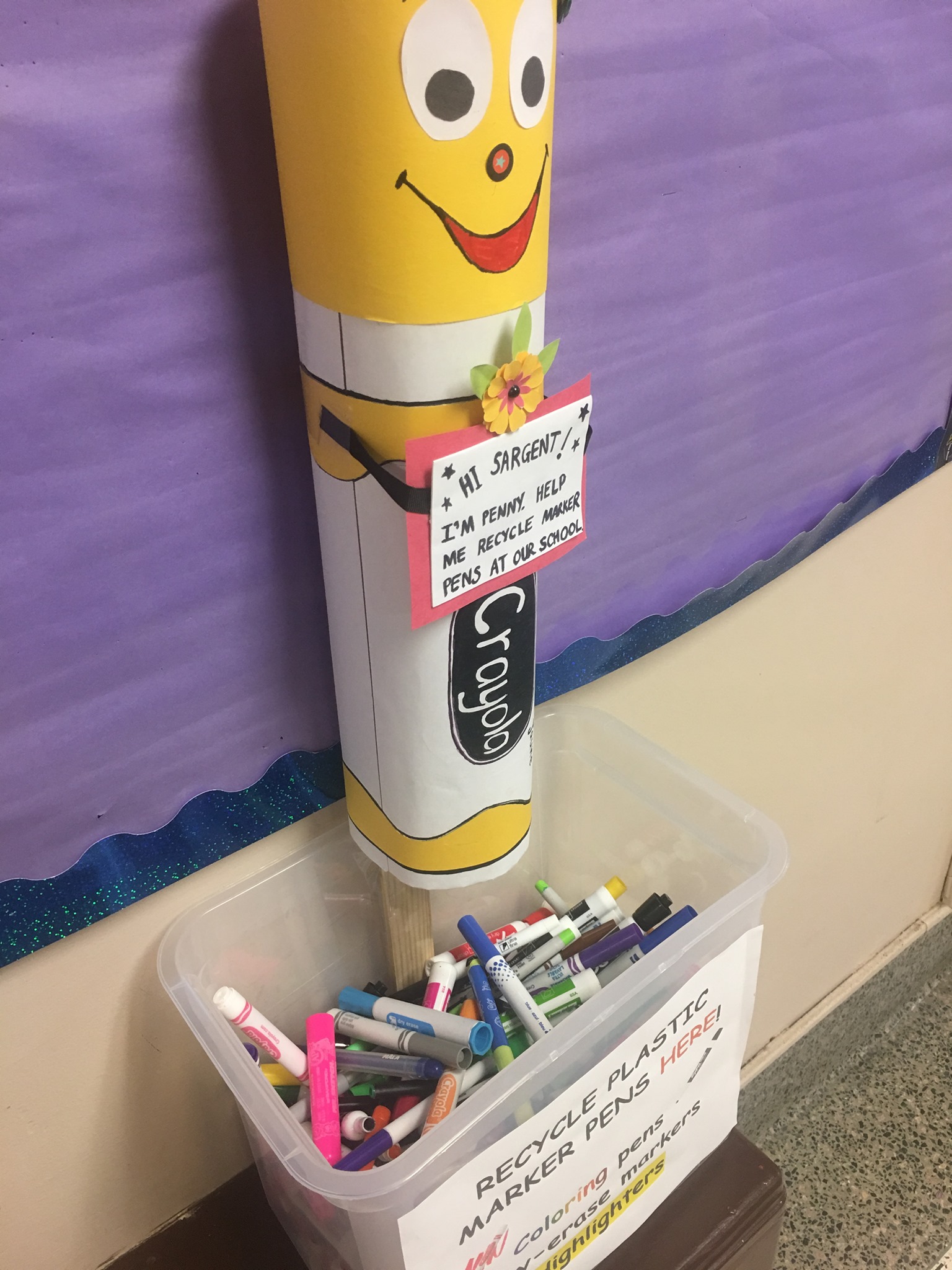
Giant Yellow Marker Collection Recycling Box At South Avenue and Sargent Elementary Schools

Photo Credit: South Avenue Elementary School

Photo Credit: South Avenue Elementary School

“Penny,” the marker collection box at Sargent Elementary. Photo Credit: Anna Sullivan Youatt

“Penny,” the marker collection box at Sargent Elementary.
Photo Credit: Anna Sullivan Youatt

With recycling markets tanking everywhere (see New York Times article “As Costs Skyrocket, More U.S. Cities Stop Recycling”) now that China is not buying most of the recycling it used to - especially from the United States - it’s clear that it’s becoming harder to recycle, and waste has been building up more than we realized.

Crayola Launches Fun Marker Collection Recycling Bins

What is catching on, therefore, is increased awareness of ways people can tweak the small stuff in their lives to get rid of stuff without throwing it into the trash. Crayola offers an initiative for schools looking to reduce waste, called ColorCycle, and information can be found here. Says South Avenue Elementary’s Principal Laura Cahill: “The South Avenue PTA started the color box in conjunction with Crayola ColorCycle, and we are encouraging families to send in their old markers throughout the year. We also put markers in here at school as they get used up during class.”

Says Ryan Green, Vice President of South Avenue’s PTA: “Any kind of marker can be collected from any brand. Dry-erase, permanent, doesn't matter. You can send them to school with your kids, and teachers send the little messengers to dump the markers into the tube.”

market collection vase.JPG

How To Contain The Dead Markers Before Depositing Into Marker Collection Box

If you’re in a house that has a high marker-loss count, where separated tops and dried-out bodies are found scattered on the floor and in the couch, they now have a place to rest and find a second life. If you don’t have a kid at South Avenue, consider setting aside your markers for a friend who does.

To get into the habit of keeping trashed markers out of the regular trash can, simply designate a pretty box or container in your home, and collect the markers over time. I just stepped on a dead blue dry-erase marker last night. Top on the floor, body on the desk. Dried out and done.

Also, Bottles and Cans Collections For Recycling And Fundraising

The South Avenue PTA, and several other PTA/Os at other schools, also have Bottle and Can Collection points where you can give the school your bottles and cans instead of putting them into your big orange-top recycling bin. It has been announced by recycling professionals at Beacon City Council meetings that glass collection is becoming difficult to sort through. Broken glass contaminates the recycling collection at large, and can make it so that big batches of waste (aka recycling materials) are no longer eligible to be recycled.

Pete Seeger Centennial Celebration - Honoring A Legend

Dona-Crawford-autunm_040.jpg

There is a special event happening Friday, May 3, 2019 to celebrate what would have been Pete Seeger's 100th birthday. The event is FREE for the public to attend, but donations to Clearwater are recommended.

The following is the press release issued by Towne Crier Public Relations in full:


Please join us on Friday, May 3 - the centennial of Pete Seeger's birth - for a spectacular evening of songs and stories honoring the Beacon songwriter, musician and activist. The Pete Seeger Centennial Celebration starts at 7 pm and will feature many local, regional and national performers paying tribute to Pete's music and life. The roster so far includes The Costellos, Carla Springer, Jerry Kitzrow, co-hosts Thom Joyce and David Bernz, singer-songwriters extraordinaire David Massengill, Christine Lavin and Don White - and the list keeps growing!

Admission is free, but donations are suggested to support Clearwater, the organization Pete founded and loved so well.

Born May 3, 1919, Pete Seeger was a legendary folksinger, musician and activist who called Beacon his home. He was a perennial supporter of the Towne Crier, too, having been one of our first performers when we started out in Beekman, and also played one of his last shows here at our Beacon location in November 2013, just a couple of months before he passed. He was a frequent visitor who also gave us our first food review in Beacon.

Days after his passing on January 27, 2014, we held a special Open Door tribute for Pete and drew the largest attendance in our history! So many wanted to share songs and stories of Pete; it was an overwhelming and emotional response to a beloved icon. He drew together diverse communities in the arts, environmental and activist circles, as well as the broader Beacon community.

Learn more about this event at The Towne Crier’s website.

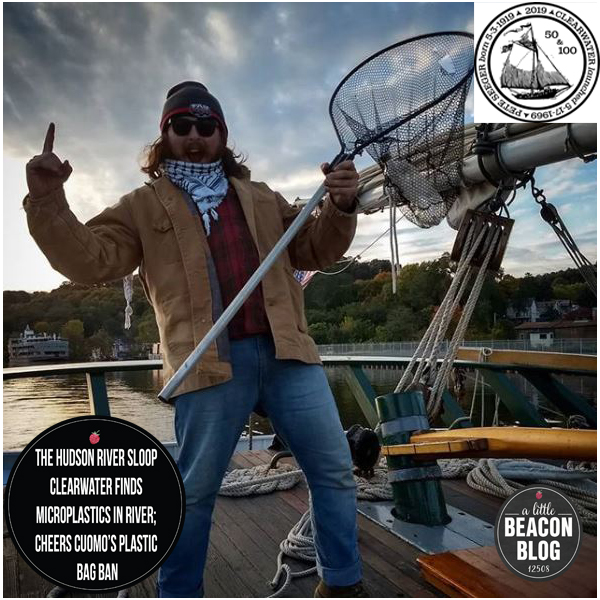
The Hudson River Sloop Clearwater Continuously Finds Microplastics In River; Cheers Cuomo’s Plastic Bag Ban

plastic.jpg

We received the following notice from Clearwater Communications about the upcoming plastic bag ban, and we thought it would be important to share with our readers. According to News 10, the plastic bags ban will take effect in March 2020 - that is less than a year away! There are concerns about the plastic bags breaking down in the water where they become ‘microplastics,’ often consumed by river and ocean wildlife.

The following is the press release issued by Clearwater Communications in full:


At a press conference on Monday, April 22, at Clearwater’s Kingston Home Port and Education Center at the Hudson River Maritime Museum, Governor Cuomo announced his signing of legislation banning single-use plastic bags in New York State. The Governor made the announcement beside Rondout Creek to an audience of reporters and environmental groups including Clearwater, Riverkeeper, Scenic Hudson and the NYS Department of Environmental Conservation.

“Microplastics” Consumed By River and Ocean Wildlife

Plastic bags have long plagued the Hudson River’s ecology, and they are a major contributor to the global ecological crisis posed by plastic pollution in the world’s rivers and oceans. Often confused for food by freshwater and marine animals, plastic bags and other plastic debris do not biodegrade. Instead, these materials break down into microscopic pieces of plastic, or “microplastics” that are consumed and bioaccumulate in fish, mammals, and birds throughout the aquatic food chain.  

“We are very concerned about the accumulation of microplastics in our waterways and fish,” said Erik Fyfe, Education Director for Clearwater. “As part of our education programs, we collect plankton from the river to show our students, and for at least the last five years, whenever we look at the plankton under a microscope we see microplastics in the water.”

More Than Just Plastic Bags

New York’s new plastic bag ban will help reduce the amount of plastic in the Hudson. Additional work is needed to address other common sources of microplastic pollution, such as synthetic clothing, cosmetics, cleaning products and air blasting media. 

“We pull plastic waste from the Hudson every day during the sailing season, whether we’re under way or not. All of it would otherwise break down into microplastics, which wind up in the water, in the fish and in anyone that eats the fish.” said Clearwater Executive Director Greg Williams. “We’re delighted Gov. Cuomo is signing the plastic bag ban bill, and is taking the opportunity to recognize environmental advocacy organizations in the process.”

The Hudson River Sloop Clearwater has dedicated the last 50 years to preserving, protecting and educating about the health of the Hudson. The Clearwater sailing crew removes trash from the river on their voyages from Albany down to New York City. 

About Hudson River Sloop Clearwater

Launched in 1969 by legendary folk singer and activist Pete Seeger, Hudson River Sloop Clearwater has been at the forefront of the environmental movement as champions of the Hudson River. To date, more than half a million people have experienced their first real look at an estuary’s ecosystem aboard the sloop Clearwater. Clearwater has become the grassroots model for producing positive changes to protect our planet. For more information, visit www.clearwater.org.

View Of A Magnolia Tree Coming Through The Overcast April Days

FullSizeRender.jpg

That’s right, April, just keep those magnolia trees blooming! We’ll take the nip in the air. And we’ll also take ourselves to A Little Beacon Blog’s Shopping Guide, to see which stores that have the rain boots, light rain ☔️ coat, and just a little pick-me-up to get through the overcast days! Head on down, everyone. Walk over to Main Street and treat yourself to a little Beacon.

This intersection is a few blocks behind Bank Square in what is quite a hilly area. Straight ahead and over a bit, you can almost spy the bright blue beBhakti Yoga Center.

First Snowfall Of March In Beacon 2019

Photo Credit: A Little Beacon Blog

Photo Credit: A Little Beacon Blog

The first snowfall of March for 2019 has fallen onto lilac tree buds and hyacinth shoots. Fear not, they have been covered before. 

The snow fell heavy and wet onto warm (well, not super-cold) ground, temperate from the Sunday before when the days had just started to warm up a bit. 

Schools in New York City are closed, with a Hazardous Travel Advisory issued by NYC, according to WNYC. Most schools in the Hudson Valley are on a two-hour delay, with some schools on a three-hour delay, or a Transportation Delay. Some Hudson Valley Schools are simply closed for the day.

Beacon City Schools are in a two-hour delay, and our delay call came last night, which helps with planning and rescheduling. Delays have become commonplace over the years when snow is expected to be on the ground in the morning. According to Beacon Superintendent Matthew Landahl, a small team from the school’s Transportation Department goes out at 3:30 am to check the roads to make a decision, since buses start their routes at 6 am.

“Since I live here,” says Dr. Landahl, “I sometimes go out and join in on the fun.” If the team finds icy patches where the buses need to drive to transport kids in and out of the district, Landahl is inclined to call a two-hour delay. Robocalls issued by Dr. Landahl have helped to keep everyone informed along the way. This morning, a call was issued to confirm the decision from the night before: that everything was good to go for the planned delay. “See you soon,” he added, and credited the city’s Highway Department and school facility teams for getting the roads clear for everyone. To follow along with other school schedules during weather, check out the list here: http://wpdh.com/snow-closings-delays/

Shoveling!

Well, you know what snowfall means: shoveling. And you know what shoveling means: chocolate chip pancakes! Or deep-dish French toast from Homespun, three-layer cake from BJs, a cheese danish from Beacon Bread Company, a hearty bagel sandwich from Beacon Bagel, or cut to the chase with a bacon egg sandwich from Mr. V’s or Bob’s. Permission granted to totally carb out.

Be safe! Don’t overdo it. Take breaks. And don’t stand under snow-covered heavy branches of snow. OK, that’s a lot to remember. Enjoy!

Bear Mountain Bridge on the morning commute from Beacon to New York City. Photo Credit: David Ray Martin

Bear Mountain Bridge on the morning commute from Beacon to New York City. Photo Credit: David Ray Martin

The east end of Main Street, before the second half of the east end of Main Street beyond Teller Avenue. Photo Credit: David Ray Martin

The east end of Main Street, before the second half of the east end of Main Street beyond Teller Avenue. Photo Credit: David Ray Martin