US Coast Guard, Armed With Mounted Gun and American Flags, Orders Sloop Clearwater To Leave Tall Ships Sail4th 250 Parade of Sail Due To Banner
/
Photo Credit: Katie Hellmuth using screenshots from Hudson River Sloop Clearwater’s videos.
“Turn your vessel around right now,” a US Coast Guard officer said into his radio microphone that projected out of the speakers on top of the Coast Guard’s small boat that was circling the Hudson Valley’s Sloop Clearwater who was sailing in the Sail4th Parade of Sail with the Tall Ships on Saturday, July 4th, 2026 at 11am, with 29 passengers and 19 crew aboard not long after the start of the event.
“We’re part of the parade! We’re in the parade.” shouted back one Clearwater passenger. “We’re here to escort -”
But they were cut off by the Coast Guard’s second command: “Turn your vessel back toward the bridge.”
“Why?” wondered another passenger. “I wonder what that could be about,” said another as the Coast Guard boat circled them.
The Coast Guard sped off to drive in front of the Clearwater, cutting it off and facing it head on while the dual currents carried both vessels, as a NYPD boat approached to reinforce the US Coast Guard.
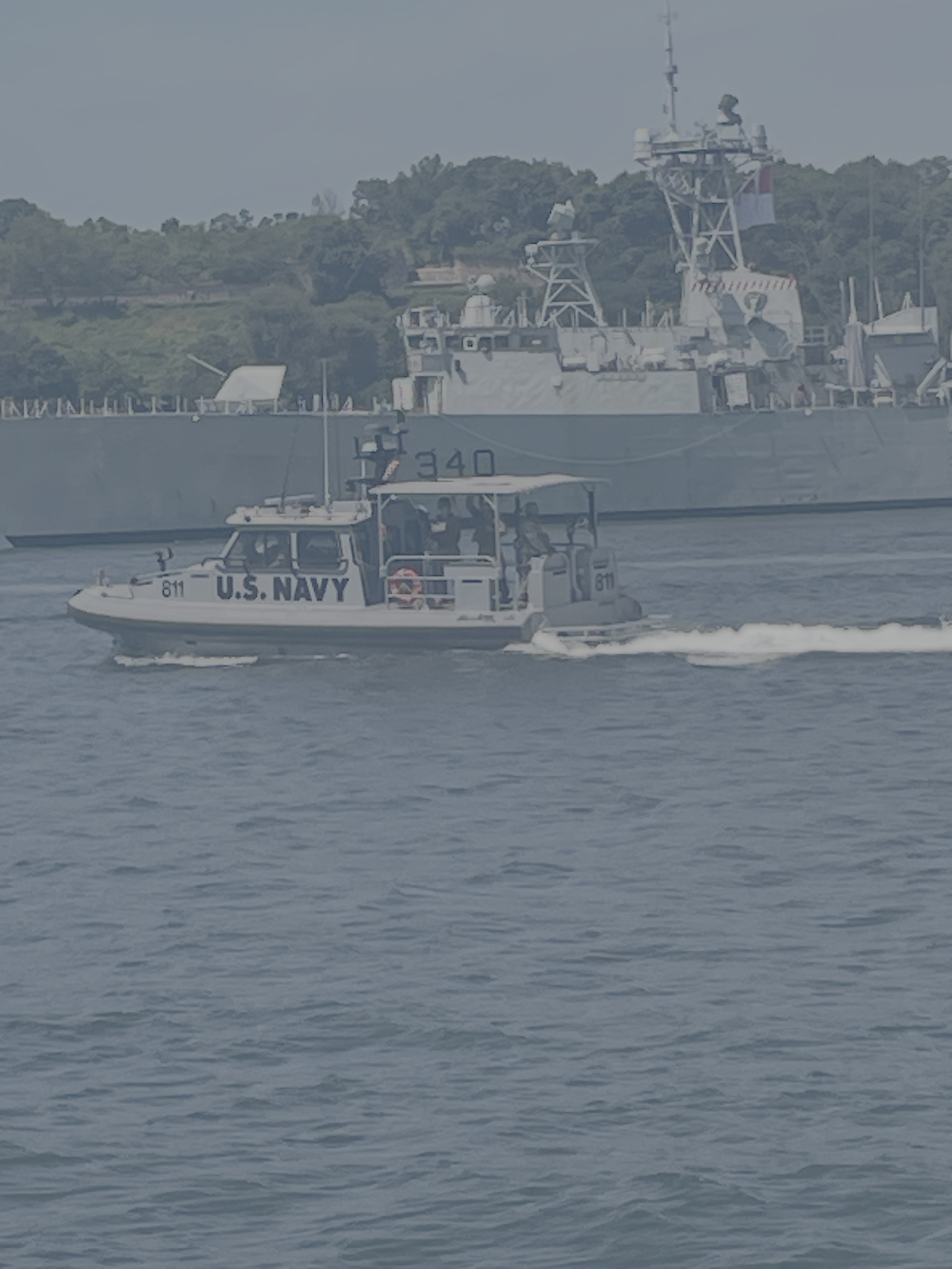
Photo Credit: Hudson Valley Sloop Clearwater
The Clearwater’s Captain Rory Kane inquired as to why, and was informed the removal was due to the presence of two banners reading: “Save the Clean Water Act” and “Indigenous Rights, Racial Justice, Climate Solutions,” the Sloop Clearwater said in a press released issued to the media at 2pm.
Sloop Clearwater confirmed that they were ordered by the Coast Guard to exit the parade and leave the “exclusion zone.” Clearwater was scheduled to escort the NRP Sagres.
A representative from Sail4th 250 informed Clearwater’s Captain the decision was above their level.
“The Sloop Clearwater has a long and storied history of using the main sales to share messages of hope and advocacy,” said the organization. “The music and fight for justice will never be silenced,” the organization stated in their Instagram release of the passengers keeping time to a banjo and harmonica.
The Clearwater continued sailing south of the Verrazano-Narrows Bridge until 3pm.
What Is The Clean Water Act?
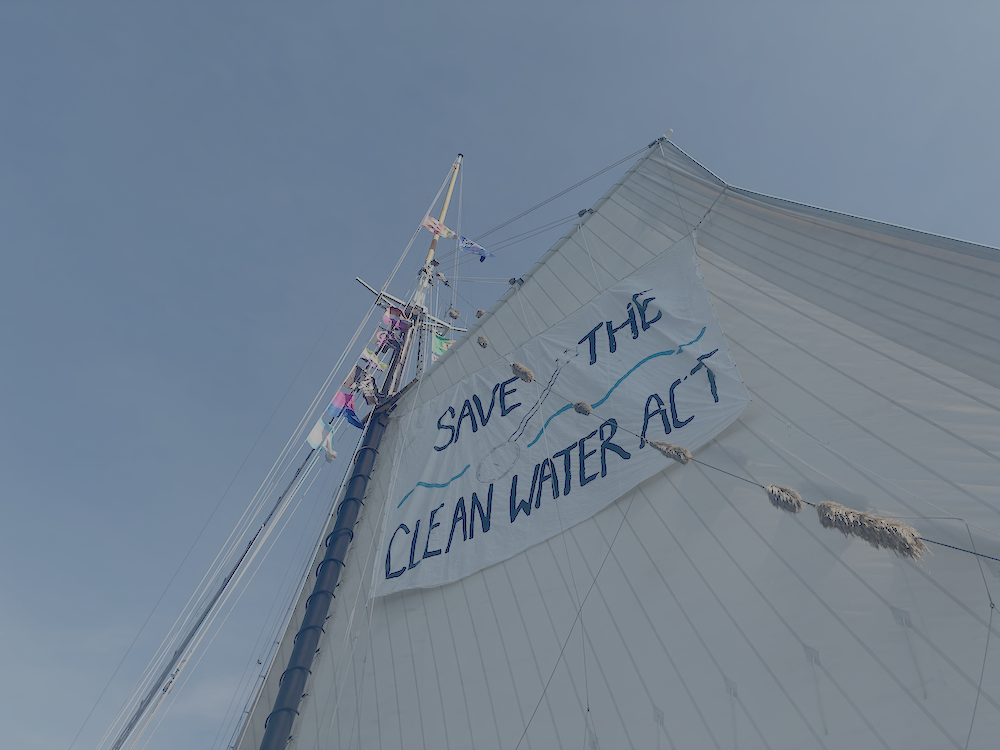
Photo Credit: Hudson Valley Sloop Clearwater
The EPA (Environmental Protection Agency) describes the Clean Water Act as:
The Federal Water Pollution Control Act of 1948 was the first major U.S. law to address water pollution. Growing public awareness and concern for controlling water pollution led to sweeping amendments in 1972. As amended in 1972, the law became commonly known as the Clean Water Act (CWA).
The 1972 amendments:
Established the basic structure for regulating pollutant discharges into the waters of the United States.
Gave EPA the authority to implement pollution control programs such as setting wastewater standards for industry.
Maintained existing requirements to set water quality standards for all contaminants in surface waters.
Made it unlawful for any person to discharge any pollutant from a point source into navigable waters, unless a permit was obtained under its provisions.
Funded the construction of sewage treatment plants under the construction grants program.
Recognized the need for planning to address the critical problems posed by nonpoint source pollution.
The Trump Administration is moving to weaken federal protections for waterways and wetlands, Inside Climate News reported in November 2025. “Environmental groups warn the proposal to change the definition of ‘waters of the United States’ would eliminate crucial safeguards for “countless” bodies of water.”
About Hudson River Sloop Clearwater
In 1966, the Hudson River was plagued by industrial pollution, and folk singer Pete Seeger and a group of activists decided to “build a boat to save the river” by bringing together communities across the region to protect and restore the river. Three years later, the sloop Clearwater set sail with a mission to save the Hudson through education, advocacy, sailing, and music.
A blog post at Pace University reads: “In 1972, Pete Seeger helped push Congress over the edge to pass the Clean Water Act by sailing the Clearwater to Washington, D.C. and delivering a petition with hundreds of thousands of signatures in support of the Clean Water Act.
As explained at Wikipedia, on August 18, 1955: “Seeger was subpoenaed to testify before the House Un-American Activities Committee (HUAC). Alone among the many witnesses after the 1950 conviction and imprisonment of the Hollywood Ten for contempt of Congress, Seeger refused to plead the Fifth Amendment (which would have suggested to many that his testimony might be self-incriminating). Instead, as the Hollywood Ten had done, he declined to name personal and political associations on the grounds that this would violate his First Amendment rights: ‘I am not going to answer any questions as to my association, my philosophical or religious beliefs or my political beliefs, or how I voted in any election, or any of these private affairs. I think these are very improper questions for any American to be asked, especially under such compulsion as this.’”
Nearly six decades later, Hudson River Sloop Clearwater remains resolute in this mission, and to date, more than half a million people have had the life-changing experience of sailing aboard the Clearwater.
Video clips from crew on the Clearwater.