Clearwater Confirms: Authorization To Be In Security Zone; Official Placement In Parade; Banners As Reason For Ejection By Sail4th 250 And U.S. Coast Guard

As A Little Beacon Blog’s article on the ejection of the sloop Clearwater by the U.S. Coastguard with mounted gun on its patrol boat, speculation and assumptions began being spread by people who supported the U.S. Coast Guard’s actions. Some falsely said that the Clearwater was not part of the parade. Not only was Clearwater very much a part of the parade, with a signed agreement, Clearwater was invited to participate in the parade by the organizers of Sail45 250.

ALBB reached out to Hudson River Sloop Clearwater for clarification on these assumptions, many of which were wrong and false. Hudson River Sloop Clearwater responded. Their answers are below:

ALBB: What permissions Did the Clearwater Have to sail in the Sail4th 250 Tall Ships?

When our captain asked the USCG why, our banners were cited as the reason. We were not given an option to remove the banners and continue in the parade.
— Hudson River Sloop Clearwater

“Clearwater was a scheduled participant, scheduled to sail on both July 3rd, 2026, in the Class B Parade, and the July 4th, 2026 Parade of Sail. See listing on Sail4th website. On Saturday, July 4, the Hudson River Sloop Clearwater was directed to leave the Sail4th 250 Parade of Sail while serving as the designated escort vessel for the Portuguese tall ship NRP Sagres after being invited to participate in Sail4th 250 by event organizers.”

ALBB: Was there a contract signed that prohibited the Clearwater from hanging banners?

“Neither the participation agreement nor the Captain's Handbook explicitly prohibited the display of these banners, and Clearwater was never offered the opportunity to remove the banners and continue in the parade. We have not received that explanation directly from event organizers.”

ALBB: Describe what was said to the Clearwater’s Captain about the banners. How did he get this communication in response? By email? By radio?

“Our communications yesterday [Saturday, July 4, 2026] with the USCG regarding our removal took place in person from adjacent vessel to adjacent vessel. We were well underway in the parade, and initially thought the USCG may have thought we were a spectator vessel that had mistakenly entered the parade route, and that was why they were telling us we needed to leave the security zone. After we clarified we were a participating vessel, they reiterated that we must exit the parade and leave the security zone.

“When our captain asked the USCG why, our banners were cited as the reason. We were not given an option to remove the banners and continue in the parade. We were not given the option to remove the banners and continue sailing either by the USCG or Sail4th 250. Our Captain inquired if the banners were removed, if we could continue sailing, and we were told to exit the parade.”

Terms and Conditions for vessels participating in Sail4th 250 are here, and do no mention banners.

“Hudson River Sloop Clearwater does not view clean water, climate solutions, or human rights as political, but as fundamental values that have guided this organization since its founding, and underlie the organization's efforts to protect the Hudson River and steward an intergenerational Hudson River community through education, advocacy, sailing, and music.”

ALBB: Was the Sloop Clearwater escorting another ship in the Parade?
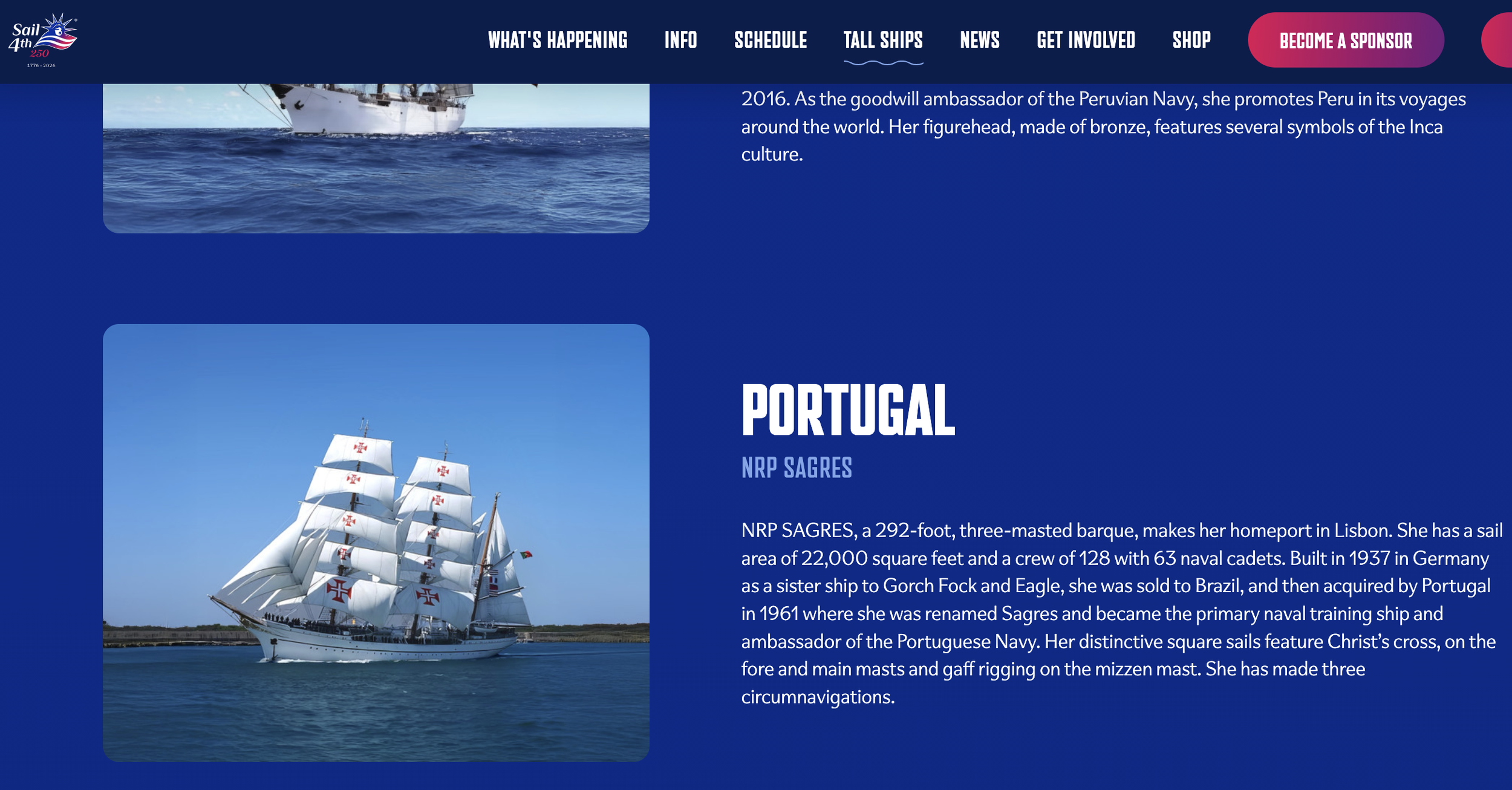
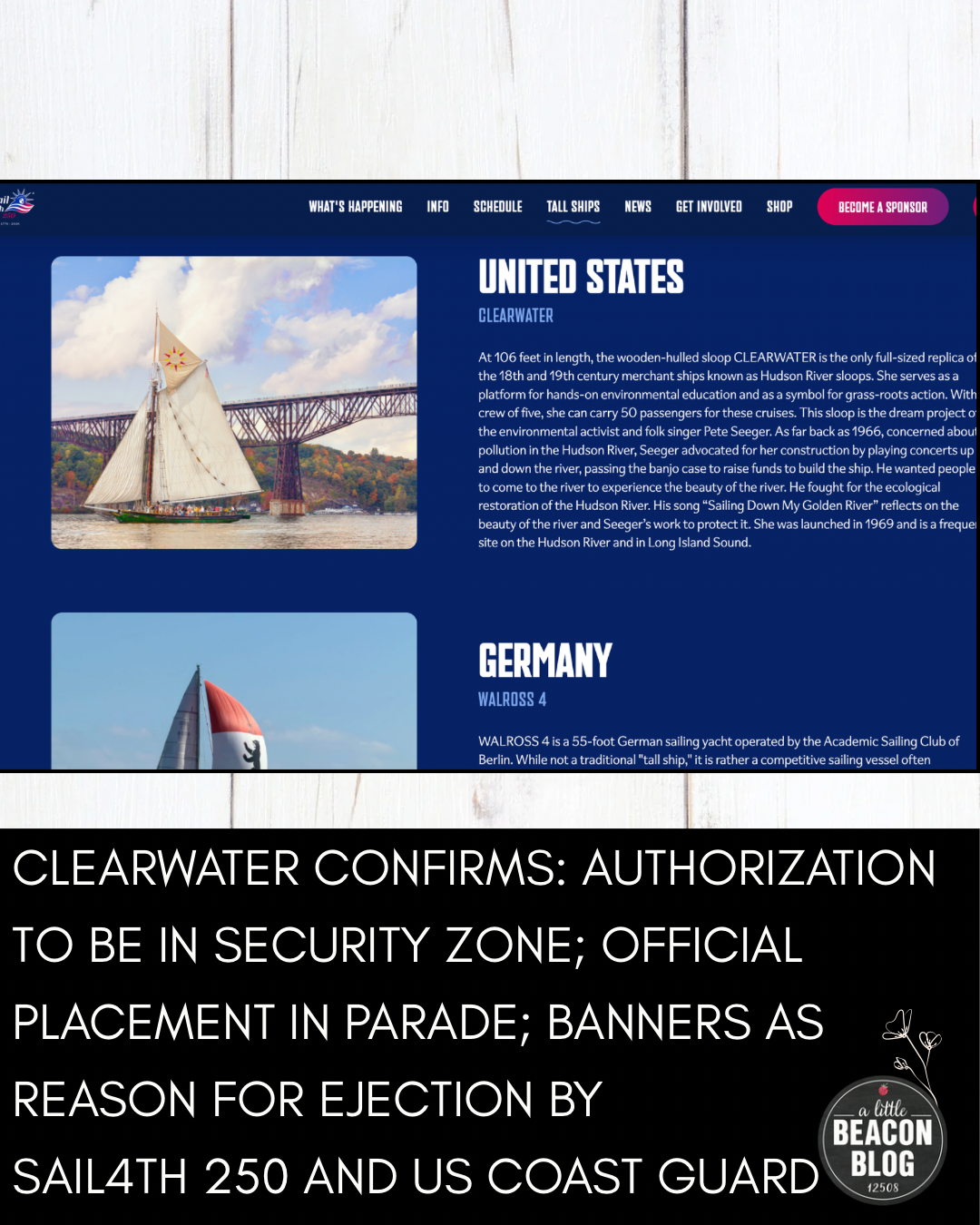
Photo Credit: ALBB; screenshot of the Sail4th 250 website list of the Tall Ships scheduled to sail in the parade. Pictured here is the ship Clearwater was to escort: Portugal’s NRP Sagres.

“Yes. In the July 4th, 2026 Parade of Sail, Clearwater was escorting the NRP Sagres.”

In the Sail4th 250’s description of the Clearwater, their website underscores the grassroots nature of this vessel’s mission: “She serves as a platform for hands-on environmental education and as a symbol for grass-roots action.”

It is accurate to state that flying two banners of statement were in keeping with the vessel’s mission.

ALBB: What is the history of Clearwater’s participation in this maritime parade?

“Clearwater sailed in Operation 1976, celebrating the 200th anniversary of the United States, and in Operation Sail 1986, which celebrated the rededication of the Statue of Liberty.”

Neither the participation agreement nor the Captain’s Handbook explicitly prohibited the display of these banners
— Hudson River Sloop Clearwater

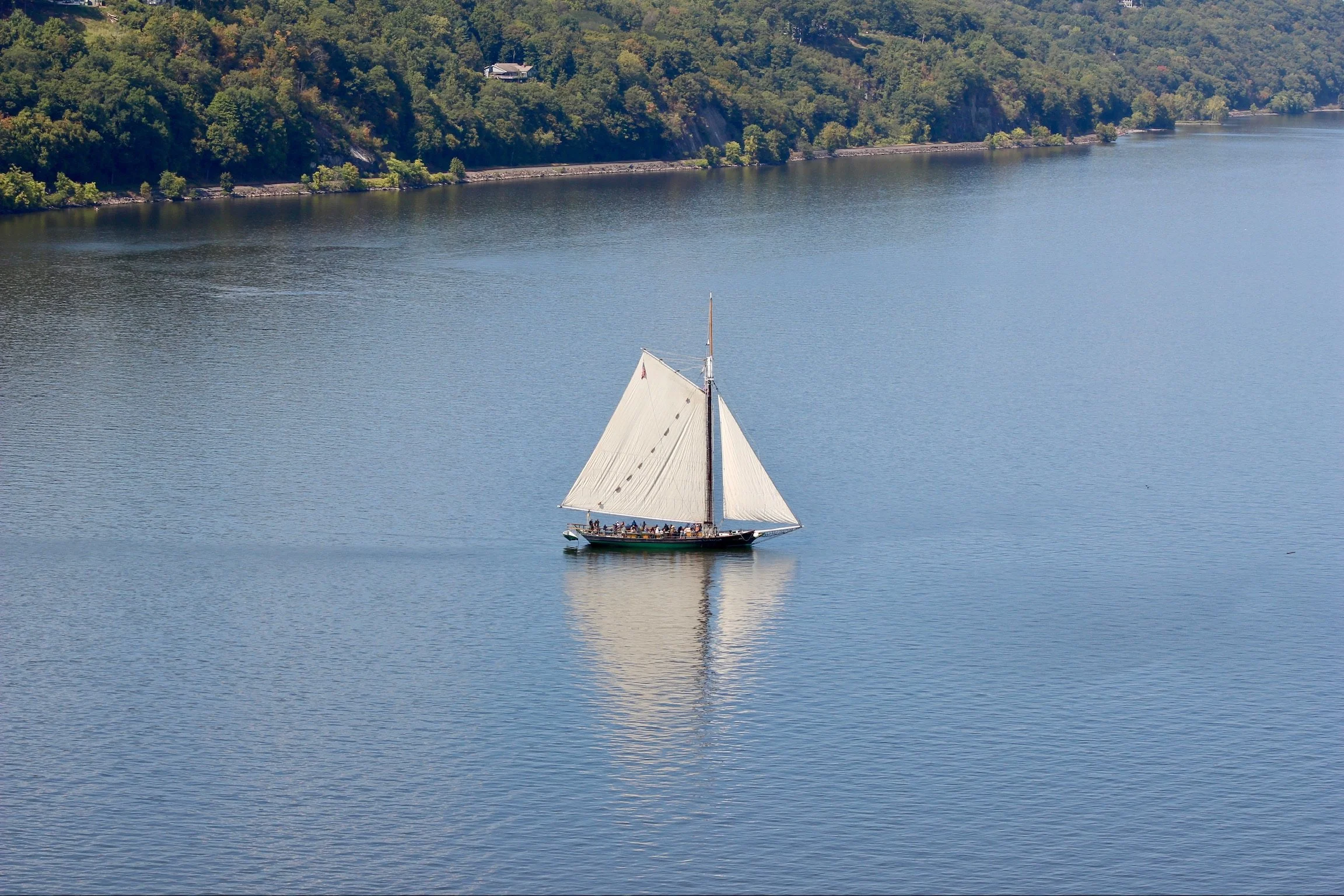
On the Sail4th 250 website, Clearwater is described as: “At 106 feet in length, the wooden-hulled sloop CLEARWATER is the only full-sized replica of the 18th and 19th century merchant ships known as Hudson River sloops. She serves as a platform for hands-on environmental education and as a symbol for grass-roots action. With a crew of five, she can carry 50 passengers for these cruises. This sloop is the dream project of the environmental activist and folk singer Pete Seeger. As far back as 1966, concerned about pollution in the Hudson River, Seeger advocated for her construction by playing concerts up and down the river, passing the banjo case to raise funds to build the ship. He wanted people to come to the river to experience the beauty of the river. He fought for the ecological restoration of the Hudson River. His song ‘Sailing Down My Golden River’ reflects on the beauty of the river and Seeger’s work to protect it. She was launched in 1969 and is a frequent site on the Hudson River and in Long Island Sound.”

ALBB: Has the Clearwater Displayed Banners During Other Parades?

“During the 1986 parade, Clearwater displayed banners reading "Peace on Earth, And Sea, and Sky" and another expressing solidarity with the Rainbow Warrior after it was bombed and sunk in Auckland Harbor. Raising awareness has been as much a part of Clearwater’s history as raising the sails.”

Hudson River Sloop Clearwater’s Reaction To The Ejection

“While we do not agree with the decision made by Sail4th 250 and enforced by the USCG, we respect the USCG, and returned south of the Verrazano-Narrows Bridge until the security zone expired at 3pm. We spent the intermediate time singing songs, discussing threats to the Hudson 'River, and fishing with our seine net to teach our passengers about the fish of NYNJ Harbor.

“We do not believe our messages were political; clean water, human rights, and climate solutions are non-partisan topics. Here on the Hudson River, we have seen the impacts of climate change firsthand, including in the last few days with two of the hottest days in 10+ years.
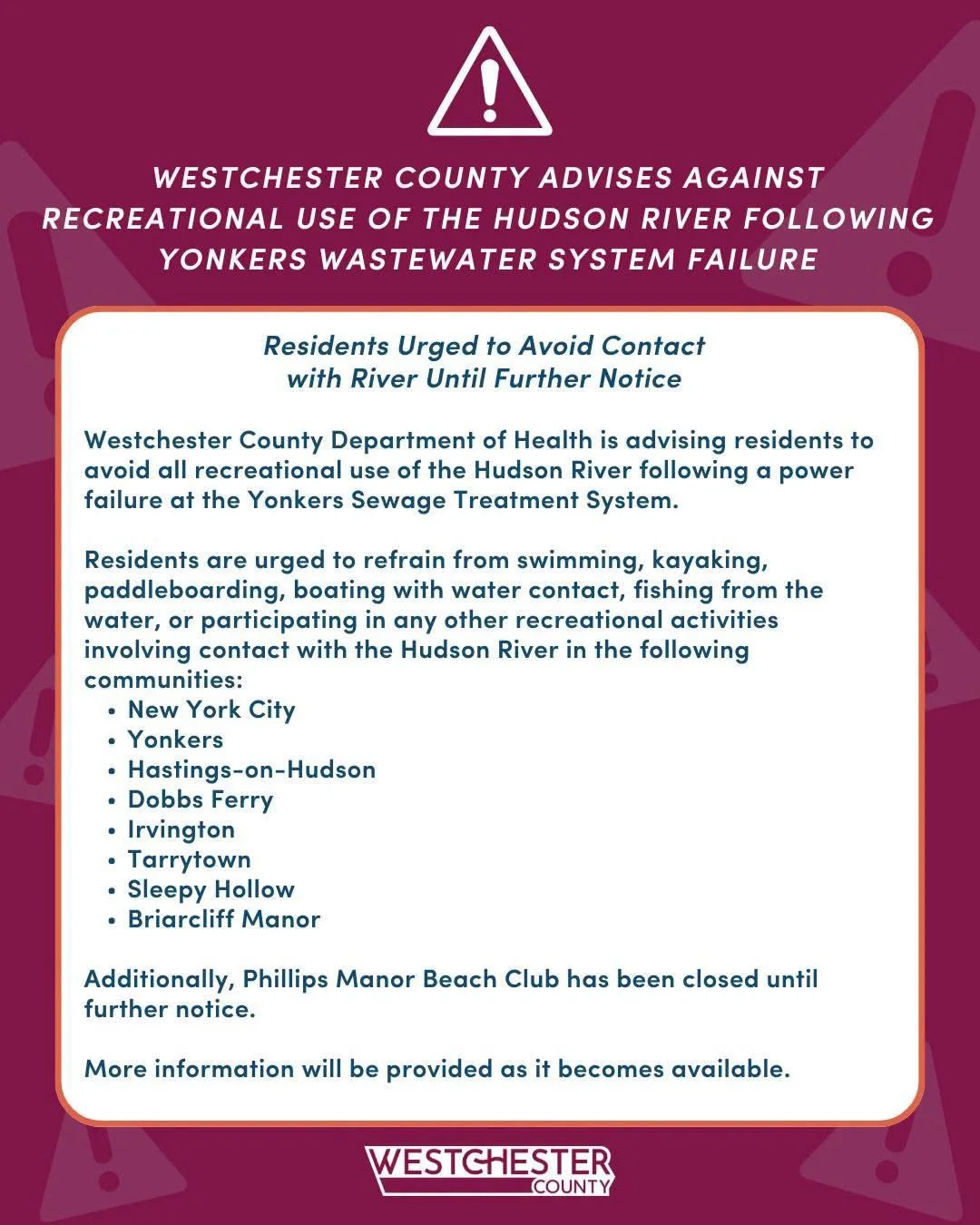
“The heat impacted people and infrastructure across the region, and put so much stress on the Westchester grid and the Westchester Wastewater Treatment Plant. There was a massive release, and regional water quality was substantially impacted.”

Regarding that release, Riverkeeper amplified the message from the Westchester County Department of Health on Friday, July 3, 2026, advising residents to avoid all recreational use of the Hudson River following a power failure at the Yonkers Sewage Treatment System.

“Residents are urged to refrain from swimming, kayaking, paddleboarding, boating with water contact, fishing from the water, or participating in any other recreational activities involving contact with the Hudson River in the following communities:

  • New York City

  • Yonkers

  • Hastings-on-Hudson

  • Dobbs Ferry

  • Irvington

  • Tarrytown

  • Sleepy Hollow

  • Briarcliff Manor

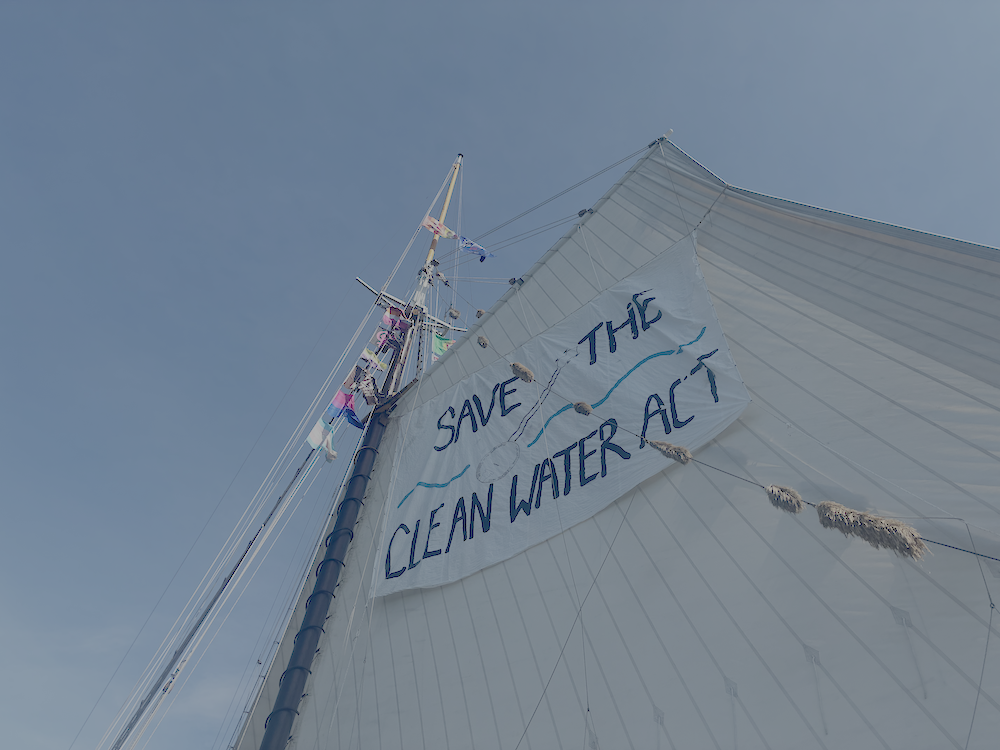
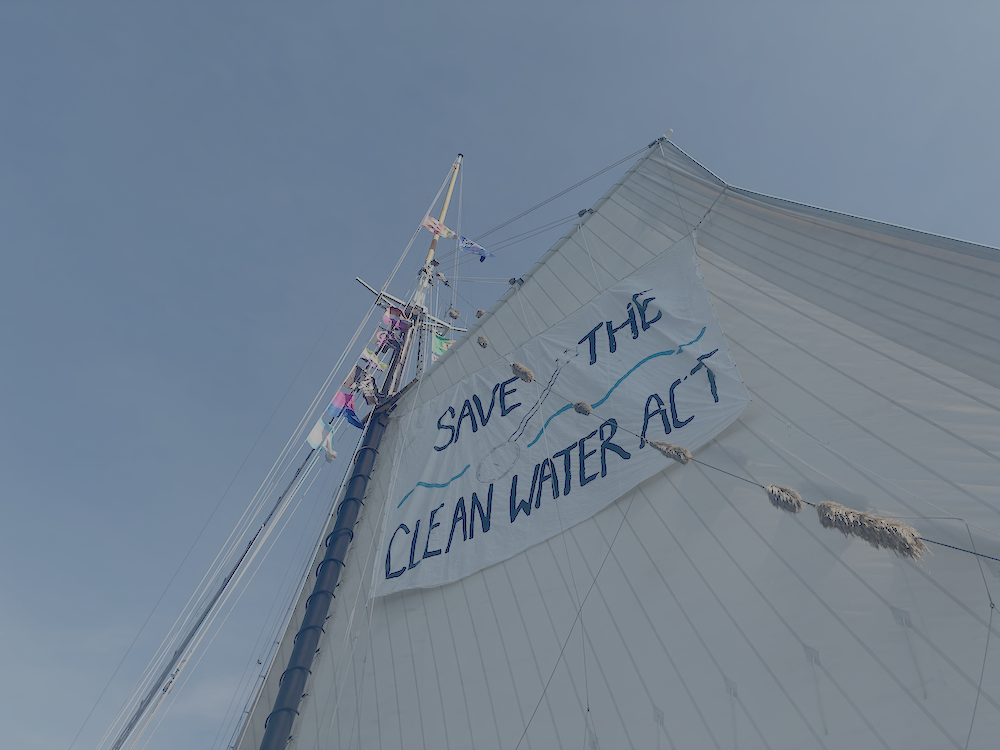
Banner on the Clearwater during the Sail4th 250 maritime parade that was banned: “Save The Clean Water Act”
Photo Credit: Hudson River Sloop Clearwater

One of the banners on the Clearwater, which is an advocacy-based name for protecting the water to keep it clean, said: “Save The Clean Water Act.”

While the sail during Operation 1976 was inspired by the need to bring people together as a unifying event (much like Beacon’s Spirit of Beacon Day in 1977 after racial eruptions between Beacon and Cold Spring), this year’s water pollution leakage came at an ironic time, making the Clearwater’s banners even more appropriate in order for all boats to continue sailing the Hudson River.

The banners read: “Save Clean Water Act” and “Indigenous Rights + Racial Justice + Climate Solutions”

In a second press release to the media send Monday, July 6, 2026, Hudson River Sloop Clearwater said: “We are grateful for the overwhelming support we have received from our members, partners, fellow mariners, and people across the country. We remain committed to protecting the Hudson River, caring for our communities, and ensuring that future generations inherit a healthy and accessible river.”
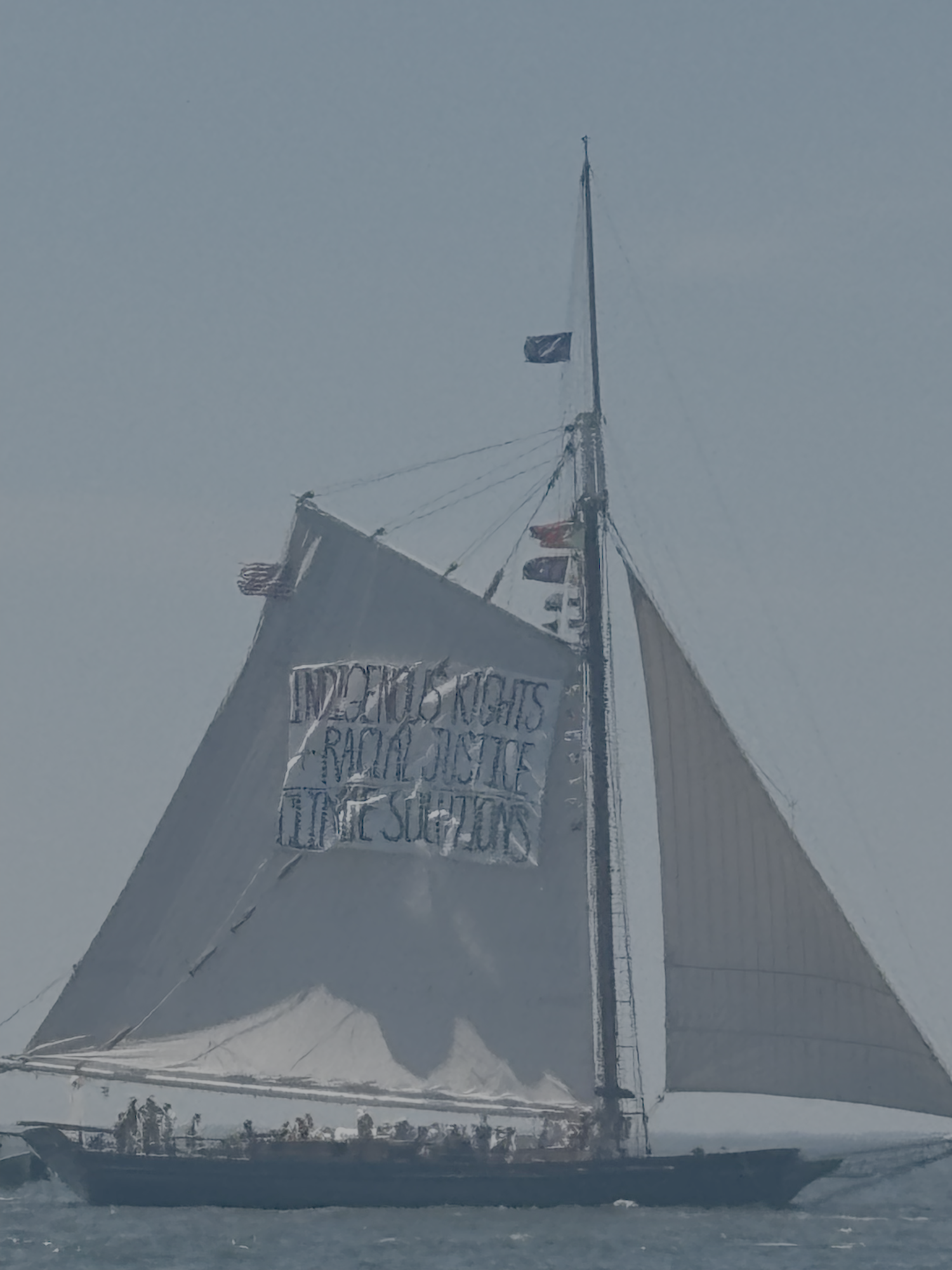
Banner on the Clearwater during the Sail4th 250 maritime parade that was banned: “Indigenous Rights + Racial Justice + Climate Solutions”
Photo Credit: Hudson River Sloop Clearwater
VIDEO: Sloop Clearwater Impact Of Being Ejected From Sail4th 250 Due To Banners For Clean Water Act, Indigenous Rights, Racial Justice, Climate Solutions

UPDATE 7/6/2016: “Clearwater Confirms: Authorization To Be In Security Zone; Official Placement In Parade; Banners As Reason For Ejection By Sail4th 250 And U.S. Coast Guard”

As neighborhood fireworks go off after tonight’s flash boom storm, which prompted the Walkway Over The Hudson to tell everyone to shelter in place, for a storm that made it to Mahopac (but their fireworks resumed after the storm passed), the reaction to the armed trolling of the Clearwater by the US Coast Guard NYPD, and the NAVY has inspired ALBB readers at Instagram to declare an “end of an era” to these 250 years of declared protections of Free Speech. The Comments on that Facebook/Instagram post have reached 701 as of this publishing.

Might we need a Declaration of Independence 2.0?

The sign that was on the Clearwater - it was to protect the Clean Water Act. Which this administration is trying to weaken. Why do you think people in our community don’t know water safety? Because we have to stay out of our waterways because of pollution messing it up. Otherwise, this town, this region, would be much more locked in to its coastal vibe.

Beacon’s legendary Pete Seeger, who founded Hudson Valley Sloop Clearwater, was strengthening the Clean Water Act. In 1955, Pete had to appear before the House Un-American Activities Committee to testify on if he was a Communist or not. Pete’s fellow activist musician and actor, Burl Ives, had named Pete as Communist after Burl was outed in a 1950 Red Channels pamphlet and was blacklisted from employment. After Burl outed Pete, the blacklist ended for Burl.

As Hudson River Sloop Clearwater said today in their Instagram post of the incident: “Nearly six decades later, Hudson River Sloop Clearwater remains resolute in this mission, and to date, more than half a million people have had the life-changing experience of sailing aboard the Clearwater.”

************

Did you like this article? Consider giving $5 🖤 💸

www.alittlebeaconblog.com/reader-support


Subscribe to ALBB’s Free Newsletter: 💌

https://mailchi.mp/alittlebeaconblog/newsletter-signup

US Coast Guard, Armed With Mounted Gun and American Flags, Orders Sloop Clearwater To Leave Tall Ships Sail4th 250 Parade of Sail Due To Banner

Photo Credit: Katie Hellmuth using screenshots from Hudson River Sloop Clearwater’s videos.

UPDATE 7/6/2016: “Clearwater Confirms: Authorization To Be In Security Zone; Official Placement In Parade; Banners As Reason For Ejection By Sail4th 250 And U.S. Coast Guard”

“Turn your vessel around right now,” a US Coast Guard officer said into his radio microphone that projected out of the speakers on top of the Coast Guard’s small boat that was circling the Hudson Valley’s Sloop Clearwater who was sailing in the Sail4th Parade of Sail with the Tall Ships on Saturday, July 4th, 2026 at 11am, with 29 passengers and 19 crew aboard not long after the start of the event.

“We’re part of the parade! We’re in the parade.” shouted back one Clearwater passenger. “We’re here to escort -”

But they were cut off by the Coast Guard’s second command: “Turn your vessel back toward the bridge.”

“Why?” wondered another passenger. “I wonder what that could be about,” said another as the Coast Guard boat circled them.

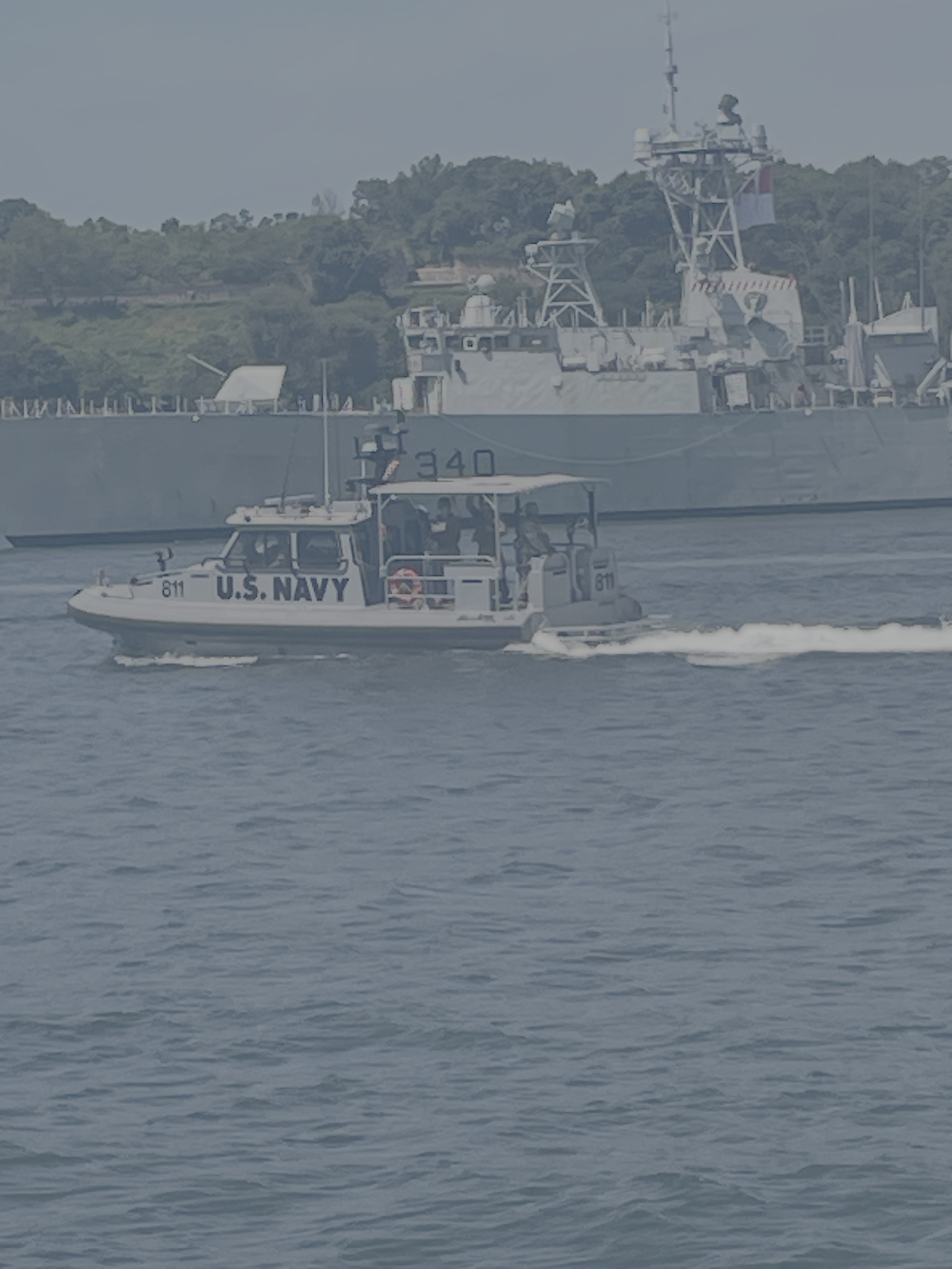
The Coast Guard sped off to drive in front of the Clearwater, cutting it off and facing it head on while the dual currents carried both vessels, as a NYPD boat approached to reinforce the US Coast Guard.

Photo Credit: Hudson Valley Sloop Clearwater

The Clearwater’s Captain Rory Kane inquired as to why, and was informed the removal was due to the presence of two banners reading: “Save the Clean Water Act” and “Indigenous Rights, Racial Justice, Climate Solutions,” the Sloop Clearwater said in a press released issued to the media at 2pm.

Sloop Clearwater confirmed that they were ordered by the Coast Guard to exit the parade and leave the “exclusion zone.” Clearwater was scheduled to escort the NRP Sagres.

A representative from Sail4th 250 informed Clearwater’s Captain the decision was above their level.

“The Sloop Clearwater has a long and storied history of using the main sales to share messages of hope and advocacy,” said the organization. “The music and fight for justice will never be silenced,” the organization stated in their Instagram release of the passengers keeping time to a banjo and harmonica.

The Clearwater continued sailing south of the Verrazano-Narrows Bridge until 3pm.

What Is The Clean Water Act?

Photo Credit: Hudson Valley Sloop Clearwater

The EPA (Environmental Protection Agency) describes the Clean Water Act as:

The Federal Water Pollution Control Act of 1948 was the first major U.S. law to address water pollution. Growing public awareness and concern for controlling water pollution led to sweeping amendments in 1972. As amended in 1972, the law became commonly known as the Clean Water Act (CWA).

The 1972 amendments:

Established the basic structure for regulating pollutant discharges into the waters of the United States.

Gave EPA the authority to implement pollution control programs such as setting wastewater standards for industry.

Maintained existing requirements to set water quality standards for all contaminants in surface waters.

Made it unlawful for any person to discharge any pollutant from a point source into navigable waters, unless a permit was obtained under its provisions.

Funded the construction of sewage treatment plants under the construction grants program.

Recognized the need for planning to address the critical problems posed by nonpoint source pollution.

The Trump Administration is moving to weaken federal protections for waterways and wetlands, Inside Climate News reported in November 2025. “Environmental groups warn the proposal to change the definition of ‘waters of the United States’ would eliminate crucial safeguards for “countless” bodies of water.”

About Hudson River Sloop Clearwater

In 1966, the Hudson River was plagued by industrial pollution, and folk singer Pete Seeger and a group of activists decided to “build a boat to save the river” by bringing together communities across the region to protect and restore the river. Three years later, the sloop Clearwater set sail with a mission to save the Hudson through education, advocacy, sailing, and music.

A blog post at Pace University reads: “In 1972, Pete Seeger helped push Congress over the edge to pass the Clean Water Act by sailing the Clearwater to Washington, D.C. and delivering a petition with hundreds of thousands of signatures in support of the Clean Water Act.

As explained at Wikipedia, on August 18, 1955: “Seeger was subpoenaed to testify before the House Un-American Activities Committee (HUAC). Alone among the many witnesses after the 1950 conviction and imprisonment of the Hollywood Ten for contempt of Congress, Seeger refused to plead the Fifth Amendment (which would have suggested to many that his testimony might be self-incriminating). Instead, as the Hollywood Ten had done, he declined to name personal and political associations on the grounds that this would violate his First Amendment rights: ‘I am not going to answer any questions as to my association, my philosophical or religious beliefs or my political beliefs, or how I voted in any election, or any of these private affairs. I think these are very improper questions for any American to be asked, especially under such compulsion as this.’”

Nearly six decades later, Hudson River Sloop Clearwater remains resolute in this mission, and to date, more than half a million people have had the life-changing experience of sailing aboard the Clearwater.

Learn more >

Video clips from crew on the Clearwater.

Hudson River Sloop Clearwater Returns to Bear Mountain for the First Time in 15 Years

Photo Credit: Hudson River Sloop Clearwater.

This past August, the Hudson River Sloop Clearwater returned to Bear Mountain State Park, docking within the park for the first time in over fifteen years. This long-awaited return was made possible through a collaborative partnership with the Palisades Interstate Park Commission and the NY State Office of Parks, Recreation, and Historic Preservation.

“Returning to Bear Mountain State Park is an exciting opportunity to connect with students and families in Rockland and Orange Counties,” said David Toman, Executive Director of Hudson River Sloop Clearwater. “Clearwater, the Palisades Interstate Park Commission, and NYS Parks share a deep commitment to connecting people with nature, history, and the Hudson River, and are thrilled to be returning to the park later this month.”

New York State Parks Commissioner Pro Tempore Randy Simons said, “We are thrilled to welcome the Clearwater back to Bear Mountain State Park. The Clearwater’s return offers an exciting opportunity to inspire the next generation of environmental stewards through their unparallelled education programs and strong community engagement along the Hudson River. We’re proud to support the historic replica’s mission and welcome it back to our park.”

Bear Mountain State Park, located 45-miles north of New York City spans 5,000 acres of open space, and is one of the most visited parks in the Northeast, hosting over 3 million visitors each year. Hudson River Sloop Clearwater, in service to their mission to protect the Hudson River and steward the next generation of Environmental Leaders, will host school groups, public sails, and deck tours on the historic Hudson River sloop.

“Returning to Bear Mountain is especially meaningful for me. As a former Clearwater Captain and crew before that, docking at Bear Mountain over three decades ago, offered a profound experience in this beautiful and dynamic part of the river,” said Samantha Hicks, Board President of Hudson River Sloop Clearwater. “To see us return is inspiring, and a testament to the power of partnership.”

Palisades Interstate Park Commission Executive Director Joshua Laird said, “Having the Clearwater return to Bear Mountain after many years is a great cause for celebration. Through the collaboration of our organizations, we have a wonderful opportunity to amplify a message about the importance of understanding history and protecting the environment. The Commission is grateful to the Sloop Clearwater for bringing its important work back to Bear Mountain along one of the most beautiful stretches of the Hudson River.”

Clearwater will be hosting public and education sails at Bear Mountain State Park next weekend on Friday, August 15 through Sunday, August 17 with sails at 1pm and 5:30pm each day. Tickets are $30 for adults and $15 for children. Additional sail dates from Bear Mountain will be listed as they are scheduled. To book public sail tickets, visit: clearwater.org/public-sails/. To book a Sailing Classroom educational field trip sail, visit: clearwater.org/education/sailing-classroom/.

About the Palisades Interstate Park Commission

The Palisades Interstate Park Commission was formed under an interstate compact in 1900 to protect the Palisades from destruction by stone and gravel quarries operating along the western banks of the Lower Hudson River. As the nation’s first bi-state partnership established to protect and conserve natural lands, the Commission’s role has expanded through the years to include more state parks and the creation of the Palisades Interstate Parkway. Today, the Commission manages 30 parks and historic sites across New York and Northern New Jersey, spanning over 125,000 acres and welcoming nine million visitors annually.

Learn more: https://www.njpalisades.org/

About Clearwater

In 1966, the Hudson River was plagued by industrial pollution, and folk singer Pete Seeger and a group of activists decided to “build a boat to save the river” by bringing together communities across the region to protect and restore the river. Three years later, the sloop Clearwater set sail with a mission to save the Hudson through education, advocacy, sailing, and music. Nearly six decades later, Hudson River Sloop Clearwater remains resolute in this mission, and to date, more than half a million people have had the life-changing experience of sailing aboard the Clearwater.