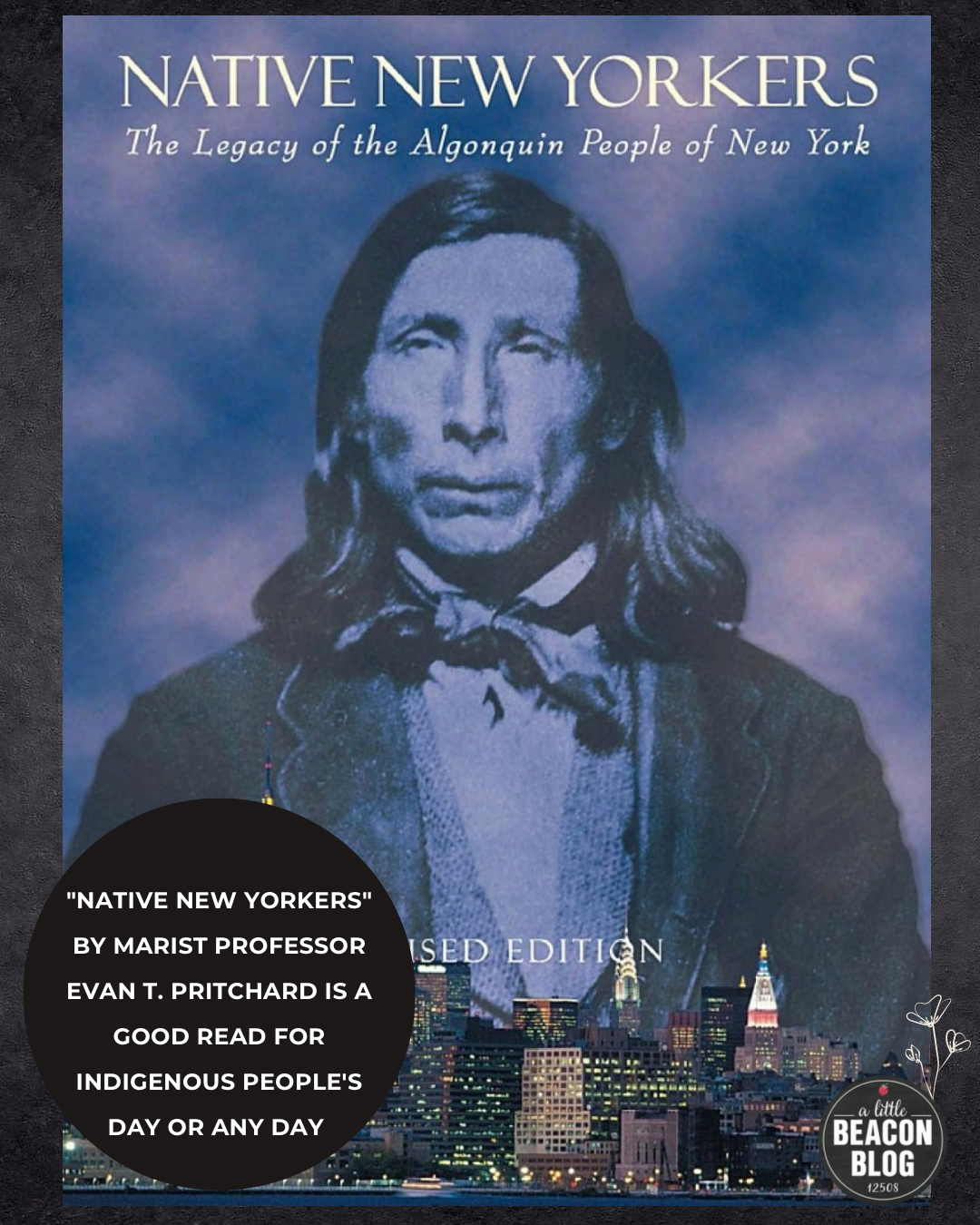
"Native New Yorkers" By Marist Professor Evan T. Pritchard Is A Good Read For Indigenous People's Day Or Any Day
/
Reading book descriptions of books that describe the history of Brown and Indigenous people as "forgotten" or as a "blueprint" can lull the reader into a sleep of acceptance; of preserving a chisel mark of history; making future violent occupations and genocides acceptable, as this one is currently in Palestine before our blinking eyes.
Native New Yorkers: The Legacy of the Algonquin People of New York is a book by Evan T. Pritchard, who is a professor of Native American history at Marist College in Poughkeepsie, where he also teaches ethics and philosophy, according to his author bio at the Chicago Review Press. Evan is a descendant of the Micmac people (part of the Algonquin nations) and is the founder of the Center for Algonquin Culture.
The book is an enchanting read. Once devoured, you will never be able to walk over Manhattan again the way you once might have. The cement and sidewalks will feel too foreign and invasive, once you have been shown how lush the land was with flowering trees and people then.
The Chicago Review describes the book simply: "A comprehensive and fascinating account of the graceful Algonquin civilization that once flourished in the area that is now New York."
Google Books describes Native New Yorkers this way: "When Giovanni da Verrazzano sailed into the New York Harbor in 1524, he climbed a hill and beheld 'campfires as plentiful as stars, as far as the eye can see.' Native New Yorkers reveals the city beneath The City, telling the fascinating story of the ancient Algonquin culture that maintained a thriving civilization in the greater New York area that is now a bustling metropolis. This book draws on a wide range of historical sources as well as extensive interviews with living Algonquin elders; exhaustively traces ancient trails, villages, burial grounds, and sacred sites and is supplemented with maps, a timeline of New York's Algonquin history, a glossary of Algonquin words, and a transcript of Giovanni da Verrazzano's letter to King Francis I of France describing his first glimpses of people of New York in 1524."
While Amazon describes the book this way: "'To be stewards of the earth, not owners': this was the way of the Lenape. Considering themselves sacred land keepers, they walked gently; they preserved the world they inhabited. Drawing on a wide range of historical sources, interviews with living Algonquin elders, and first-hand explorations of the ancient trails, burial grounds, and sacred sites, Native New Yorkers offers a rare glimpse into the civilization that served as the blueprint for modern New York. A fascinating history, supplemented with maps, timelines, and a glossary of Algonquin words, this book is an important and timely celebration of a forgotten people."
Even to call it a "celebration of forgotten people," blesses the occupiers who claimed to "discover" it.
Evan also authored Henry Hudson and the Algonquins of New York and No Word for Time: The Way of the Algonquin People, and other books.
Chapters from Native New Yorkers include:
How GREEN WAS MANHATTAN
A PARADISE FOR THE LIVING
A WALK AROUND OLD MANHATTAN
EXPLORING THE ANCIENT CITY The Bronx Brooklyn Queens and Staten Island
VERRAZZANO AND HIS LEGACY
WE BELONG TO THE EARTH
THE TWOCOLORED SNAKE A History of the Dutch Occupation of New York
THE WORLD OF THE LENAPE
SWEET AND FULL OF MEANING The Languages of Manhattan
PART II THE LEGENDARY HUDSON VALLEY
THE HEAD OF THE WOLF Orange and Ulster Counties
A WALK DOWN THE MINISINK TRAIL
NATIVE NEW YORKERS OF STONY COUNTRY Rockland County
NATIVE NEW YORKERS OF THE NORTH THE MOHICAN Dutchess Columbia Rensselaer Washington Saratoga Schenectady Albany and Greene
PART III LONG ISLAND LONG AGO
THE THIRTEEN TRIBES OF LONG ISLAND
CONCLUSION
EPILOGUE
MUNSEE VOCABULARY
TWELVE LEVELS OF ALGONQUIN HISTORY IN NEW YORK STATE
THE VERRAZZANO DIARY LETTER TO FRANCIS I OF FRANCE
TIME LINE OF LENAPE HISTORY
Buy this book locally in Beacon from Binnacle Books or Stanza Books. Each can special order it if not in stock. Stop into the independent book shops to see what else they have, like journals, stationery and cards.
In Cold Spring, visit Split Rock Books, and “in so-called Kingston,” visit Blackbird Infoshop & Café.
A Reminder Of The Name Of "The Hudson River" Before European Occupation
According to the Hudson River Valley Institute: "This region was a river valley long before the river was named for Henry Hudson. At the time of contact with European explorers and colonists, the Mohicans who lived in the region referred to it as the Mahicannituk, often translated as 'the river that flows both ways,' or 'the waters that are never still.'
"When researching the Native American history of a region, it is important to remember the context in which that history was recorded. Nearly all the first-hand accounts which have survived were written by Europeans who were, by definition, foreign to the lifeways of America’s original inhabitants. Even in the best circumstances with sympathetic explorers, missionaries, or colonists, whatever aspects of indigenous culture and history were captured had been seen through the lens of European culture by an individual who was participating to some extent in some phase of colonization."
The Hudson River Valley Institute reminds us of which groups were living in the Hudson River Valley before Europeans came: "Today the Hudson River Valley encompasses lands that, prior to colonization, were occupied by five groups: the Munsee Lenape, Wappinger, Schaghticoke, Mohican, and Haudenosaunee (Iroquois). Their boundaries overlapped and changed prior to and after the arrival of the colonists, but they maintain a connection to lands in the region. The following pages provide overviews of those five groups as well as bibliographies and online resources.